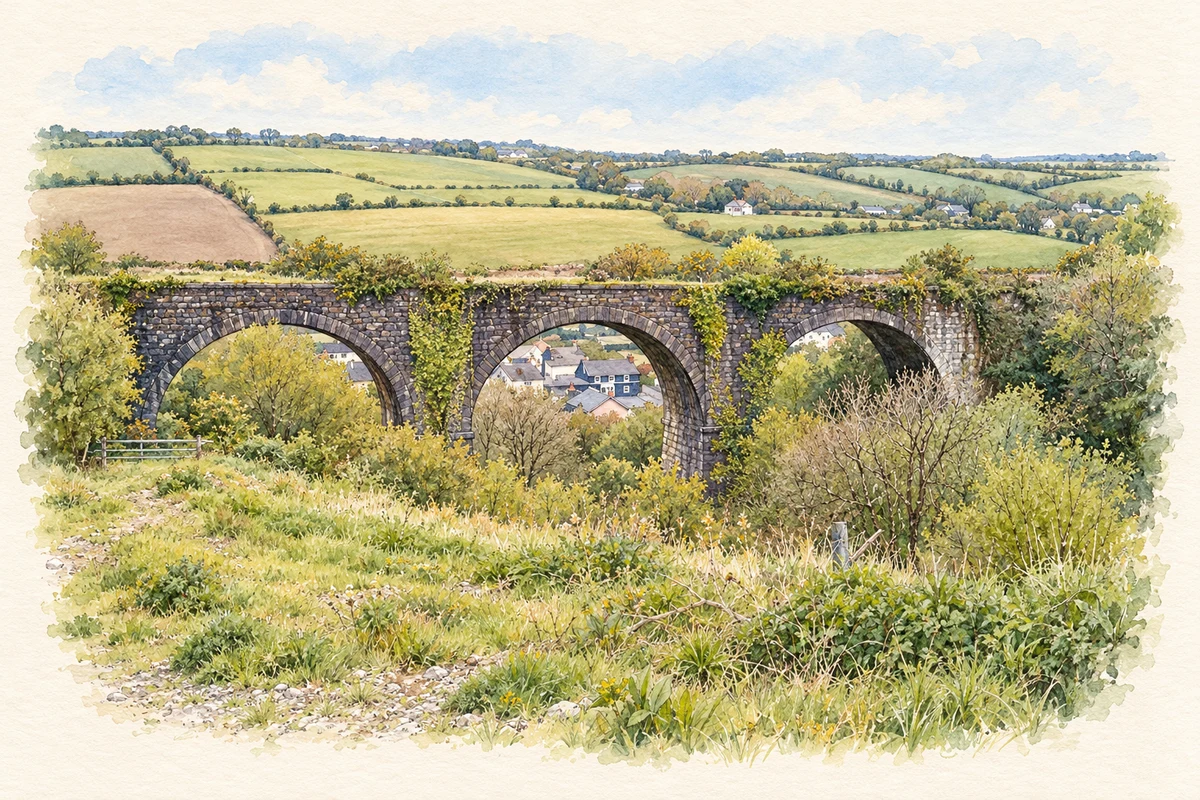
Halfway’s transport history survives in the old Cork–Bandon road and the limestone viaduct above it. Its more recent social history includes the Ramble Inn’s association with vintage vehicles.
Illustration, Halfway Viaduct near Ballinhassig
⊕Recorded locationHalfway51.80444° N · 8.57115° WInteractive map supplied by OpenStreetMap.
A reliable full-name meaning has not been established here. The recorded Irish and English forms are given without an unsupported translation.
Recorded forms
Halfway· English · main form
Place & story
A village held between hill and river
Halfway developed along the old Cork–Bandon road, with steeply rising ground to the north and the Owenboy River to the south. Cork County Council’s 2005 plan identified the disused railway on the higher ground and Priest’s Bridge at the village’s western edge. This narrow setting helps explain the settlement’s linear form. Road, river and hillside constrained its growth and gave transport routes a particularly visible place in the village landscape.[2]
Three arches above the valley
Work on Halfway Viaduct began in 1847. Three round-headed limestone arches carried the Cork, Bandon and South Coast Railway over a gorge cut by a tributary of the Owenboy. Dressed stone piers, carefully cut arch stones and parapets give the structure a substantial presence above the village. Although railway use ended, the viaduct remained. It preserves the engineering response to a difficult valley crossing on a route that once connected Cork with towns throughout West Cork.[3]
People & connections
Alan and Mary Barry’s Ramble Inn
Alan Barry bought the Ramble Inn in 1981 and, with his wife Mary, ran it for forty-four years before its closure in June 2025. In Noel Sweeney’s interview with him shortly before the closure, Barry recalled expanding the yard and hosting vintage car and tractor runs. The premises also accommodated funerals, family celebrations and community gatherings. That account identifies the pub as a social meeting place and a gathering point for transport enthusiasts, adding a later chapter to Halfway’s longstanding association with roads and railways.[4]
Both counts use the 2016 settlement boundary, allowing like-for-like comparison. CSO supplies the 2022 count on this older boundary for comparison only. The official 2022 Built Up Area has different boundaries.
View population figures
Halfway — Census 2016 settlement footprint — census population
These figures use different area definitions. Read the boundary note before comparing them.
Halfway, Cork
Published census settlement populations
226people · 2016
Settlement boundaries changed during this period. Differences may reflect boundary changes as well as population change. Where a 2011 legal-town-and-environs count is shown, it has not been recalculated onto the 2016 settlement boundary.
 placenames