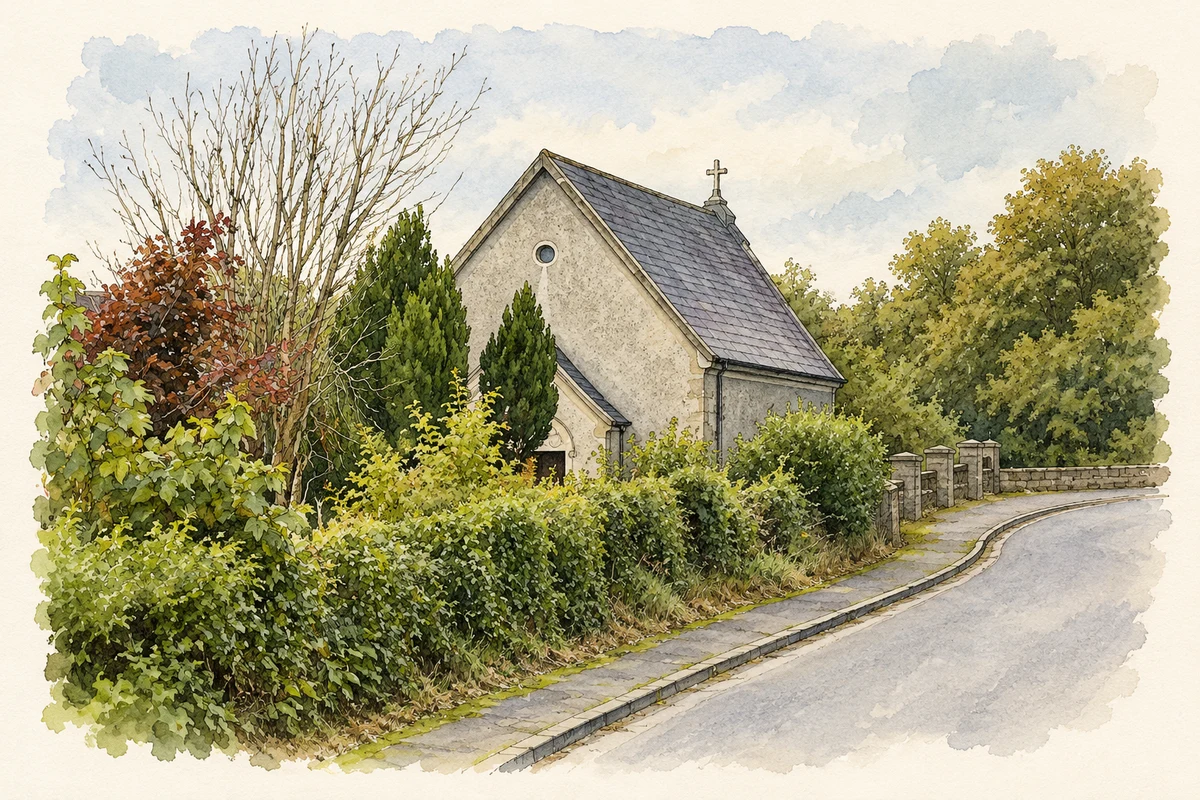
A reliable full-name meaning has not been established here. The recorded Irish and English forms are given without an unsupported translation.
Recorded forms
Fathain· Irish · main form · validated name
Fahan· English · main form
Place & story
The cross-slab at Saint Mura’s
Fahan's carved cross-slab is among the distinctive early medieval monuments of Inishowen. The National Inventory of Architectural Heritage describes interlaced crosses and two human figures among its decoration. Although often assigned an early date, the inventory notes scholarship suggesting that it may be as late as the tenth century. Local tradition identifies it with Saint Mura's burial place. The surviving carving is evidence of an important religious site; its precise date and identification as the saint's own grave-marker remain separate questions.[2][3]
People & connections
Agnes Jones and nursing reform
Agnes Elizabeth Jones, associated with Fahan, entered Florence Nightingale's nursing school at Saint Thomas's Hospital in London in 1862. She became nursing superintendent at Liverpool's Brownlow Hill Infirmary in 1865, bringing trained nurses and probationers into workhouse care. She died of typhus in 1868, aged thirty-five, and was buried at Fahan. Ulster University commemorated her work with the local parish in 2020. Her grave places the story of nineteenth-century nursing reform within a churchyard better known for its much older religious monuments.[4][5]
Relics carried beyond the parish
Objects associated with Saint Mura survive beyond Fahan itself. The local heritage group identifies a crozier and chain in the National Museum of Ireland and a bell-shrine in London's Wallace Collection. The Wallace Collection dates the bell object across the eleventh to sixteenth centuries, reflecting a history later than the saint's lifetime. The museum display describes the chain as pieces of mail and records beliefs about girdles used during childbirth. These are historical accounts of devotional practices, not evidence that the relic possessed protective powers.[6][7]
Both counts use the 2016 settlement boundary, allowing like-for-like comparison. CSO supplies the 2022 count on this older boundary for comparison only. The official 2022 Built Up Area has different boundaries.
View population figures
Fahan — Census 2016 settlement footprint — census population
These are the historical areas published in the 2006 census report. Boundaries may differ between censuses and from modern settlements. Legal towns, environs and suburbs are shown separately; none has been combined into a modern settlement total.
View population figures
Fahan, Donegal — Census town, CSO 2006 report — census population
These are the historical areas published in the 1996 census report. Boundaries may differ between censuses and from modern settlements. Legal towns, environs and suburbs are shown separately; none has been combined into a modern settlement total.
View population figures
Fahan, Donegal — Census town, CSO 1996 report — census population
Figures cover the historical town area printed in the 1986 report. Boundaries may have changed between censuses. Legal town, environs and suburb totals remain separate and differ from modern settlement boundaries.
View population figures
Fahan, Donegal — Census town, CSO 1986 report — census population
These figures use different area definitions. Read the boundary note before comparing them.
Fahan, Donegal
Published census settlement populations
588people · 2016
Settlement boundaries changed during this period. Differences may reflect boundary changes as well as population change. Where a 2011 legal-town-and-environs count is shown, it has not been recalculated onto the 2016 settlement boundary.
 placenames