These Irish name elements are associated with this record in the Logainm glossary.
An element’s translation is a clue, rather than a complete explanation of the name. Its form and meaning depend on local history and the full Irish name.
Recorded forms
Cluain Maine· Irish · main form · validated name
Clonmany· English · main form
Place & story
The Morrisons and the Miosach
The Morrison family held an important position in Clonmany's religious history as hereditary custodians of church property and of the Miosach, an ornate book-shrine. The local conservation group's account describes the shrine's wooden core and later metal decoration, including an inscription dated 1534. It is now in the National Museum of Ireland. A belief that it once held a manuscript written by Colmcille belongs to its devotional tradition. The object and its inscription preserve a more tangible connection with the families who cared for it.[2]
Building the old church at Straid
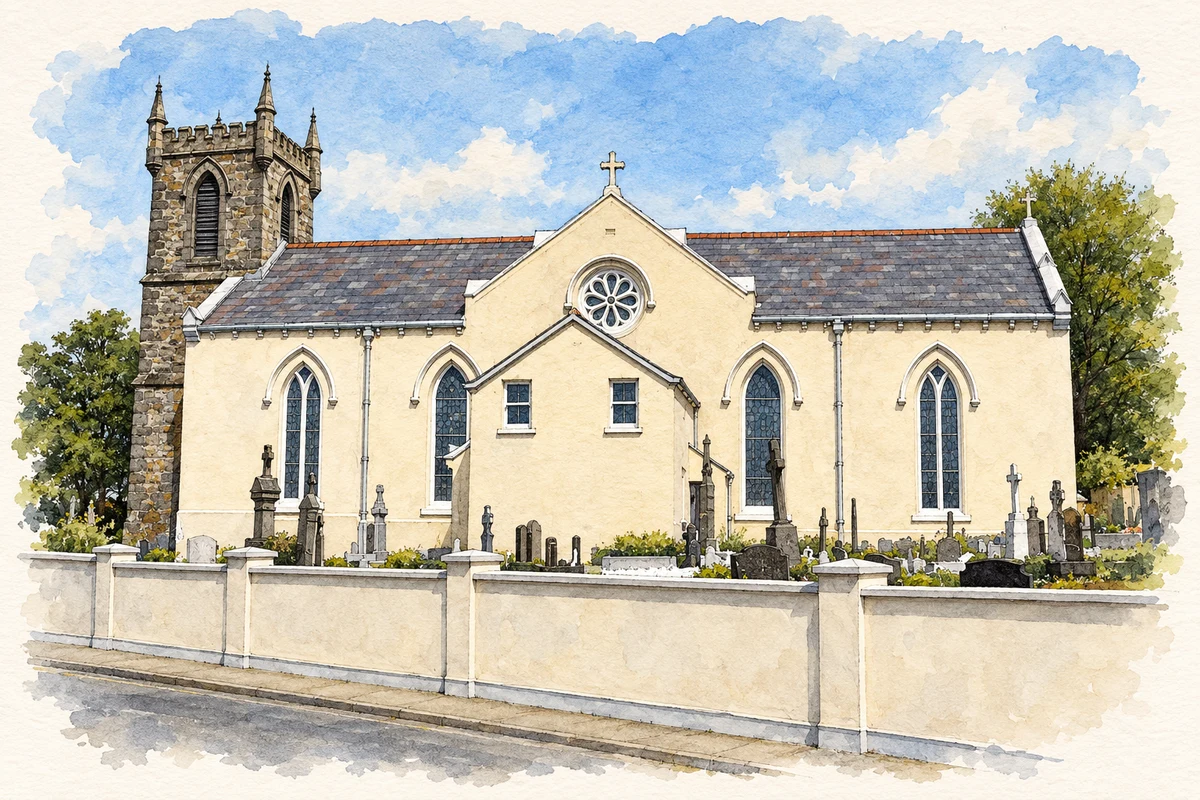
Historian Seán Beattie connects the eighteenth-century church at Straid with the patronage of the Earl Bishop, Frederick Hervey, and the Reverend William Chichester. He identifies the Cork-born builder and designer Michael Shanahan with the work, linking Straid to the Earl Bishop's better-known architectural projects. The churchyard also holds clergy and families from different religious backgrounds. Its history is therefore more layered than the story of a single congregation: the building stands within a burial landscape that has served the wider parish over generations.[3]
Folklore & tradition
The monastery remembered in a meadow
Rosemarie Doherty's account of early Christian Clonmany records Charles McGlinchey's recollection of a small triangular piece of ground beside the old church, believed locally to mark a monastery. He also remembered stories of its well. Another tradition associated a stone in the graveyard with Colmcille's knees. Doherty distinguishes these oral accounts from the physical evidence and notes uncertainty over the site's original saintly association. They explain how particular corners and stones became meaningful to local people without establishing a precise foundation date.[4]
Both counts use the 2016 settlement boundary, allowing like-for-like comparison. CSO supplies the 2022 count on this older boundary for comparison only. The official 2022 Built Up Area has different boundaries.
View population figures
Clonmany — Census 2016 settlement footprint — census population
These are the historical areas published in the 2006 census report. Boundaries may differ between censuses and from modern settlements. Legal towns, environs and suburbs are shown separately; none has been combined into a modern settlement total.
View population figures
Clonmany, Donegal — Census town, CSO 2006 report — census population
These are the historical areas published in the 1996 census report. Boundaries may differ between censuses and from modern settlements. Legal towns, environs and suburbs are shown separately; none has been combined into a modern settlement total.
View population figures
Clonmany, Donegal — Census town, CSO 1996 report — census population
Figures cover the historical town area printed in the 1986 report. Boundaries may have changed between censuses. Legal town, environs and suburb totals remain separate and differ from modern settlement boundaries.
View population figures
Clonmany, Donegal — Census town, CSO 1986 report — census population
These figures use different area definitions. Read the boundary note before comparing them.
Clonmany, Donegal
Published census settlement populations
428people · 2016
Settlement boundaries changed during this period. Differences may reflect boundary changes as well as population change. Where a 2011 legal-town-and-environs count is shown, it has not been recalculated onto the 2016 settlement boundary.
Saint Mary's Church, Clonmany illustration: based on a Clonmany R C Church, Co. Donegal by Dr Neil Clifton. AI-assisted watercolour and ink adaptation; cream paper margins added, incidental clutter omitted and fine details simplified. Licence: CC BY-SA 2.0.
 placenames