An Spidéal's cultural history includes a pioneering Irish college, St Enda's distinctive church and the early life of disability-rights campaigner Martin Naughton.
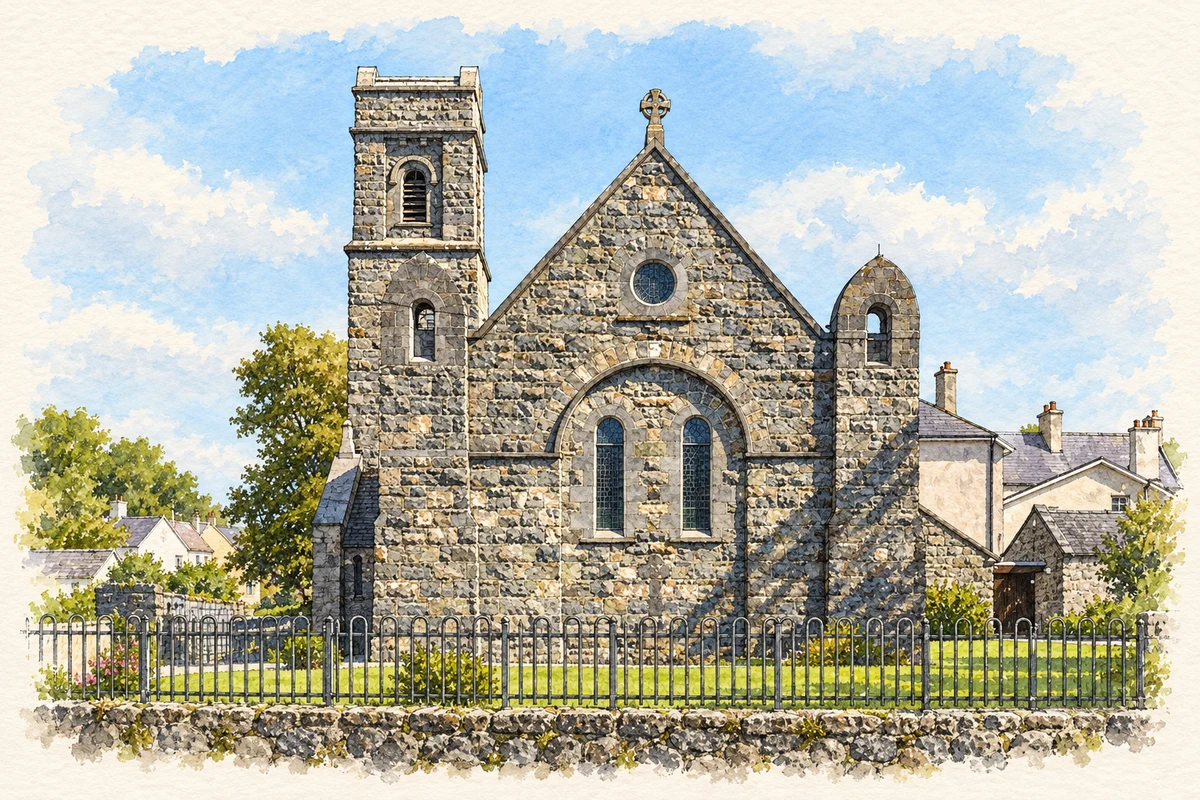
Illustration, Cill Éinde, Church of St Enda, Spiddal
⊕Recorded locationSpiddle53.24553° N · 9.30364° WInteractive map supplied by OpenStreetMap.
A reliable full-name meaning has not been established here. The recorded Irish and English forms are given without an unsupported translation.
Recorded forms
An Spidéal· Irish · main form · validated name
Spiddle· English · main form
Spiddal· English · main form · local name
Place & story
Shelter on Galway Bay
Samuel Lewis described Spiddal as a village in Moycullen parish in 1837. Its pier, built by the Fishery Board, was then the only shelter for boats on this side of Galway Bay. The brief entry records a practical maritime role for a settlement now also associated with language learning and the arts. The shore and pier were central to how this coastal community connected with the bay.[2]
St Enda's and its Irish inscriptions
St Enda's is distinguished by its tall rectangular tower and saddle roof. Writing about his family's parish church in 1950, Lord Killanin described its granite walls, limestone window dressings and glass made by Sarah Purser's studio. The Stations of the Cross, installed between 1916 and 1918, use painted-glass mosaic, or opus sectile. Their titles are in Irish; Killanin observed that the church's other inscriptions were Irish or Latin. His account preserves the close relationship between the building's art and its Gaeltacht setting.[3]
A college that moved from Mayo
Coláiste Chonnacht began in Tourmakeady, County Mayo, in 1906. Founded by the Gaelic League, it trained teachers to teach Irish. In 1910 it moved to Sheeaunroe House in Spiddal, where its summer courses continued. The college's own history lists Patrick Pearse and Éamon de Valera among its early students. Its move brought an established language-teaching project into the village and helped make Spiddal a place where learners could study within an Irish-speaking community.[4]
People & connections
Martin Naughton's Spiddal beginnings
Disability-rights activist Martin Naughton was born in Spiddal in 1954 and attended the village national school. His father farmed a smallholding east of the village and worked with horses. Naughton later helped establish the Dublin Center for Independent Living in 1992 and campaigned for personal-assistant services that enabled disabled people to live in their own homes. He also co-founded Áiseanna Tacaíochta. After his death in 2016, he was buried in Spiddal beside his sister Maureen, returning his story to the community where it began.[5][6]
Both counts use the 2016 settlement boundary, allowing like-for-like comparison. CSO supplies the 2022 count on this older boundary for comparison only. The official 2022 Built Up Area has different boundaries.
View population figures
An Spidéal — Census 2016 settlement footprint — census population
These are the historical areas published in the 2006 census report. Boundaries may differ between censuses and from modern settlements. Legal towns, environs and suburbs are shown separately; none has been combined into a modern settlement total.
View population figures
An Spidéal, Galway — Census town, CSO 2006 report — census population
These figures use different area definitions. Read the boundary note before comparing them.
An Spidéal, Galway
Published census settlement populations
237people · 2016
Settlement boundaries changed during this period. Differences may reflect boundary changes as well as population change. Where a 2011 legal-town-and-environs count is shown, it has not been recalculated onto the 2016 settlement boundary.
 placenames