These Irish name elements are associated with this record in the Logainm glossary.
An element’s translation is a clue, rather than a complete explanation of the name. Its form and meaning depend on local history and the full Irish name.
Recorded forms
An Chill· Irish · main form · validated name
Kill· English · main form
Place & story
The road through the village
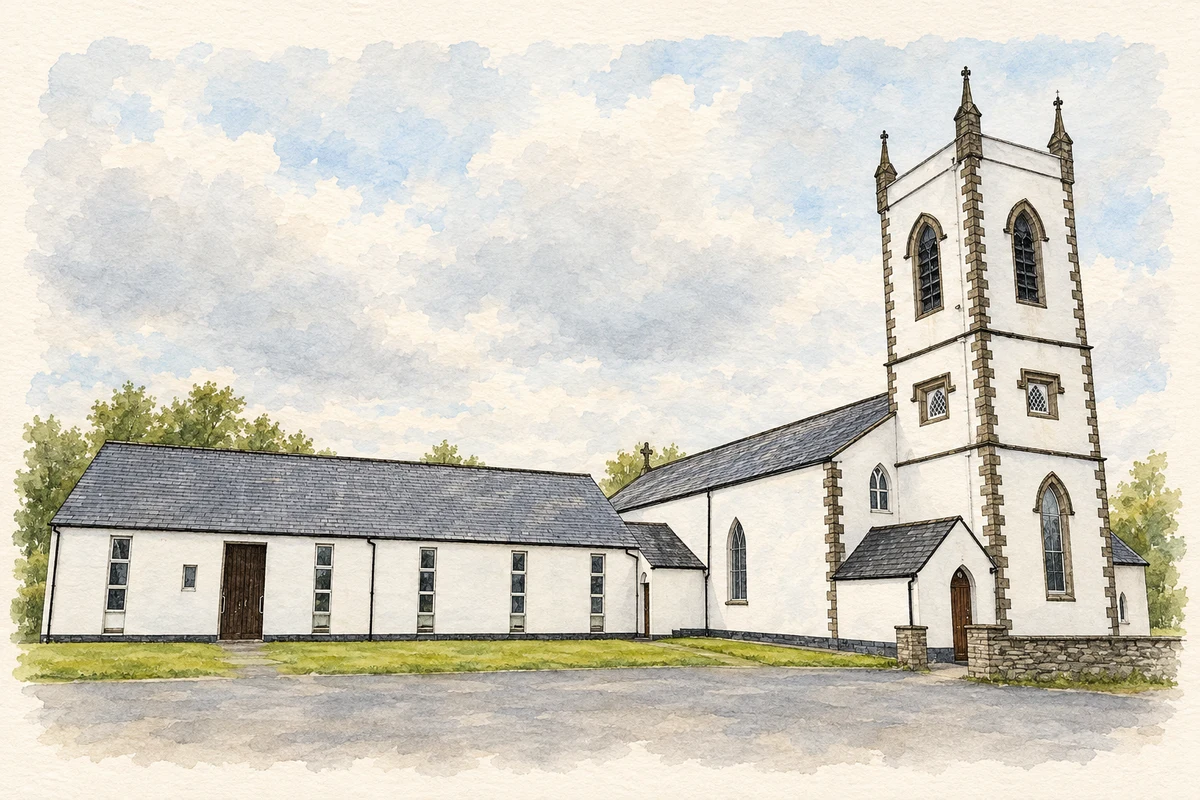
Kill once stood on the main road south from Dublin, before a bypass opened in 1956. Its community biodiversity plan describes a village organised around the main street, crossed by the Kill River and lined with two churches, an old stone school and longstanding hostelries. Farming and bloodstock were important local activities, alongside sand and gravel extraction. From the 1970s, housing growth increasingly connected Kill with the greater Dublin commuter area. The old street and river crossing preserve the geography of the earlier roadside village within that larger settlement.[2]
People & connections
John Devoy returns to Greenhills
A report in the Kildare Observer of 9 August 1924 describes the veteran Fenian John Devoy returning to Greenhills, Kill, his native place. Accompanied by relatives and friends, he identified where his family home had stood, although the newspaper said nothing of the house remained. He then continued to Naas and met Elizabeth Kilmurry, to whom he had once been engaged. The report records his surprise at finding her alive after having believed for many years that she had died. It is a contemporary account of an emigrant's return to a remembered local landscape.[3]
People & connections
The schoolhouse and the uilleann pipes
Liam Óg O'Flynn was educated by his father in Kill's old schoolhouse, a connection recorded in the community biodiversity plan. His later work carried the uilleann pipes into widely heard recordings and collaborations. In a tribute after his death in 2018, President Michael D. Higgins recalled O'Flynn's contribution to the founding of Na Píobairí Uilleann in 1968 and his performances with Planxty, Seamus Heaney and Shaun Davy. Kill's school building therefore has a direct connection with a musician central to the modern transmission of Irish piping.[2][4]
Both counts use the 2016 settlement boundary, allowing like-for-like comparison. CSO supplies the 2022 count on this older boundary for comparison only. The official 2022 Built Up Area has different boundaries.
View population figures
Kill — Census 2016 settlement footprint — census population
These are the historical areas published in the 2006 census report. Boundaries may differ between censuses and from modern settlements. Legal towns, environs and suburbs are shown separately; none has been combined into a modern settlement total.
View population figures
Kill, Kildare — Census town, CSO 2006 report — census population
These are the historical areas published in the 1996 census report. Boundaries may differ between censuses and from modern settlements. Legal towns, environs and suburbs are shown separately; none has been combined into a modern settlement total.
View population figures
Kill, Kildare — Census town, CSO 1996 report — census population
Figures cover the historical town area printed in the 1986 report. Boundaries may have changed between censuses. Legal town, environs and suburb totals remain separate and differ from modern settlement boundaries.
View population figures
Kill, Kildare — Census town, CSO 1986 report — census population
These figures use different area definitions. Read the boundary note before comparing them.
Kill, Kildare
Published census settlement populations
3,348people · 2016
Settlement boundaries changed during this period. Differences may reflect boundary changes as well as population change. Where a 2011 legal-town-and-environs count is shown, it has not been recalculated onto the 2016 settlement boundary.
 placenames