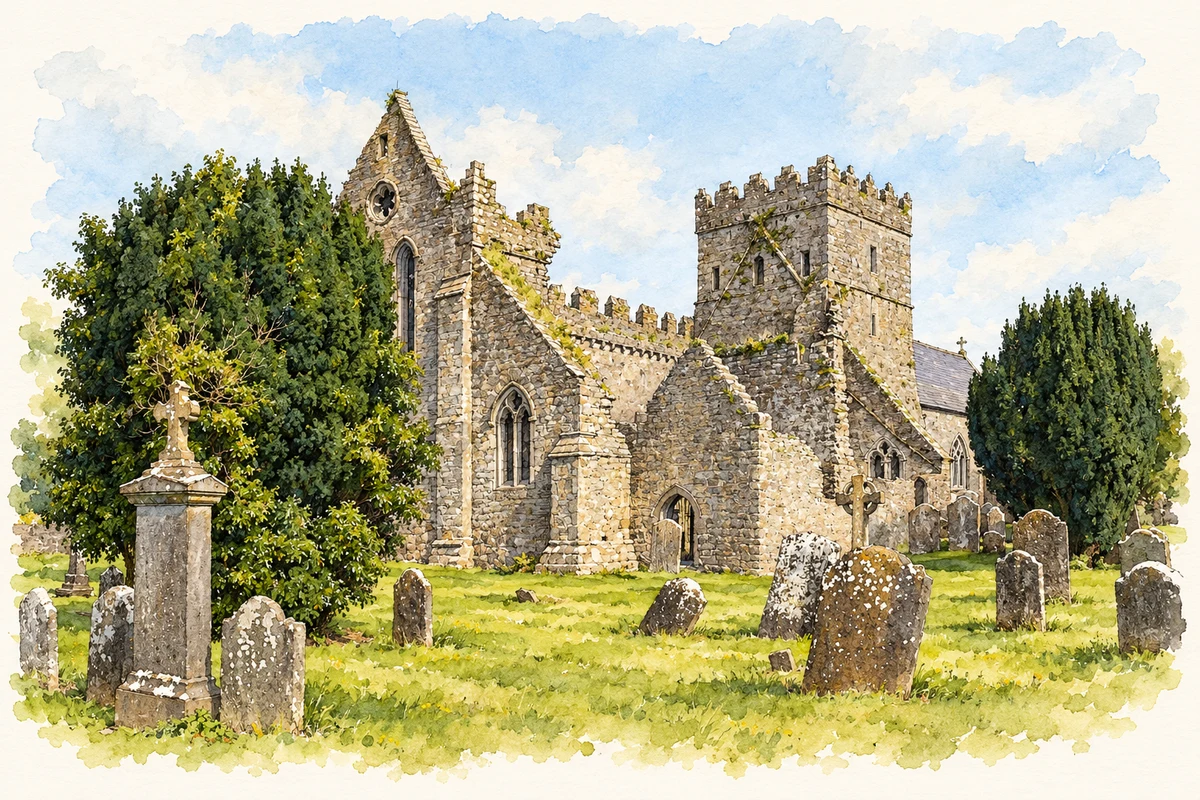
St Mary's at Gowran holds a remarkable sequence of stone carving and memorials, from an ogham stone reused in its foundations to twentieth-century stained glass.
Illustration, St Mary's Collegiate Church, Gowran
⊕Recorded locationGowran52.62976° N · 7.06909° WInteractive map supplied by OpenStreetMap.
A reliable full-name meaning has not been established here. The recorded Irish and English forms are given without an unsupported translation.
Recorded forms
Gabhrán· Irish · main form · validated name
Gowran· English · main form
Place & story
A college of clergy
St Mary's was built in the late thirteenth century as a collegiate church. Its clergy lived as a community without following a monastic rule. The Butler family patronised the church, and elaborate tombs commemorate members of the family. Its surviving ruins and roofed later church preserve different phases of this long religious history. The collection of carvings and monuments also records how successive patrons used the building as a place of burial and remembrance, leaving names, figures and religious imagery in stone.[2]
A reused stone and carved knights
An ogham stone was reused in the medieval church's foundations and rediscovered during nineteenth-century rebuilding. It also bears an early Latin cross, bringing two forms of inscription together on the same object. A pair of effigial tombs commemorates Butler knights. The more elaborate is believed to represent Sir James Butler of Polestown, father of Piers Rua, eighth earl of Ormond. Its sides carry apostles, St Brigid and a Crucifixion scene. The carving is attributed to the O'Tunney workshop of Callan, an important name in late medieval Irish sculpture.[3]
People & connections
Wyatt, Healy and McGoldrick
The roofed Church of Ireland building was erected to Thomas Henry Wyatt's 1871 design and later restored by the Office of Public Works in 1994–95. Inside, a 1918 window by Michael Healy of An Túr Gloine commemorates Lieutenant Aubrey Cecil White, killed at the Somme in 1916. Hubert McGoldrick created a second memorial window in 1920 for Hector James Charles Toler-Aylward of Shankill Castle. These works brought the Irish Arts and Crafts stained-glass movement into a church already rich in medieval and classical memorial sculpture, extending its tradition of remembrance into a new medium.[4]
Both counts use the 2016 settlement boundary, allowing like-for-like comparison. CSO supplies the 2022 count on this older boundary for comparison only. The official 2022 Built Up Area has different boundaries.
View population figures
Gowran — Census 2016 settlement footprint — census population
These are the historical areas published in the 2006 census report. Boundaries may differ between censuses and from modern settlements. Legal towns, environs and suburbs are shown separately; none has been combined into a modern settlement total.
View population figures
Gowran, Kilkenny — Census town, CSO 2006 report — census population
These are the historical areas published in the 1996 census report. Boundaries may differ between censuses and from modern settlements. Legal towns, environs and suburbs are shown separately; none has been combined into a modern settlement total.
View population figures
Gowran, Kilkenny — Census town, CSO 1996 report — census population
Figures cover the historical town area printed in the 1986 report. Boundaries may have changed between censuses. Legal town, environs and suburb totals remain separate and differ from modern settlement boundaries.
View population figures
Gowran, Kilkenny — Census town, CSO 1986 report — census population
These figures use different area definitions. Read the boundary note before comparing them.
Gowran, Kilkenny
Published census settlement populations
804people · 2016
Settlement boundaries changed during this period. Differences may reflect boundary changes as well as population change. Where a 2011 legal-town-and-environs count is shown, it has not been recalculated onto the 2016 settlement boundary.
 placenames