These Irish name elements are associated with this record in the Logainm glossary.
An element’s translation is a clue, rather than a complete explanation of the name. Its form and meaning depend on local history and the full Irish name.
Recorded forms
Cionn Locha· Irish · main form · validated name
Kinlough· English · main form
Place & story
A small centre for fairs and services
In 1837 Lewis counted about thirty houses in Kinlough. Monthly fairs took place on the sixth, while petty sessions met every third Monday. A police station, dispensary, churches and school supplied services to the surrounding countryside. He also noted a nearby mineral spring that had formerly attracted visitors. This compact collection of institutions shows the village's role as a local meeting and trading place, alongside the larger landed properties and the landscape of Lough Melvin.[2]
People & connections
The Johnston family's lands
The Johnstons came from Fermanagh and acquired Leitrim land in the early eighteenth century. Their seat at Kinlough was also known as Oakfield. Estate records trace their interests well beyond the immediate village: members held property in Galway, Donegal and Longford as well as Leitrim. By the 1870s William Johnston of Kinlough owned more than ten thousand acres in County Leitrim. Surviving rentals and estate-sale papers document the scale and changing ownership of these holdings.[3]
The bellcote of St Aidan's
St Aidan's Catholic Church dates from 1854 and forms a conspicuous landmark in Kinlough. Its cruciform plan has a nave, chancel and transepts, with a decorated bellcote rising above the entrance. Paired lancet windows, trefoils and a rose window bring variety to the stone exterior. Red and yellow brick around some openings adds colour beside the dressed stonework. Its construction and stained glass preserve a substantial investment in nineteenth-century village worship and craftsmanship.[4]
Everyday life in the folk museum
Kinlough Folk Museum brings domestic and working objects together on Barrack Street. Its recreated public house has a long counter and lift-up hatch, while a kitchen display includes an open hearth, settle bed and household utensils. Newspaper cuttings, tools and agricultural implements widen the collection beyond the home, preserving material evidence of the rural economy served by the village.[5]
Both counts use the 2016 settlement boundary, allowing like-for-like comparison. CSO supplies the 2022 count on this older boundary for comparison only. The official 2022 Built Up Area has different boundaries.
View population figures
Kinlough — Census 2016 settlement footprint — census population
These are the historical areas published in the 2006 census report. Boundaries may differ between censuses and from modern settlements. Legal towns, environs and suburbs are shown separately; none has been combined into a modern settlement total.
View population figures
Kinlough, Leitrim — Census town, CSO 2006 report — census population
These are the historical areas published in the 1996 census report. Boundaries may differ between censuses and from modern settlements. Legal towns, environs and suburbs are shown separately; none has been combined into a modern settlement total.
View population figures
Kinlough, Leitrim — Census town, CSO 1996 report — census population
Figures cover the historical town area printed in the 1986 report. Boundaries may have changed between censuses. Legal town, environs and suburb totals remain separate and differ from modern settlement boundaries.
View population figures
Kinlough, Leitrim — Census town, CSO 1986 report — census population
These figures use different area definitions. Read the boundary note before comparing them.
Kinlough, Leitrim
Published census settlement populations
1,032people · 2016
Settlement boundaries changed during this period. Differences may reflect boundary changes as well as population change. Where a 2011 legal-town-and-environs count is shown, it has not been recalculated onto the 2016 settlement boundary.
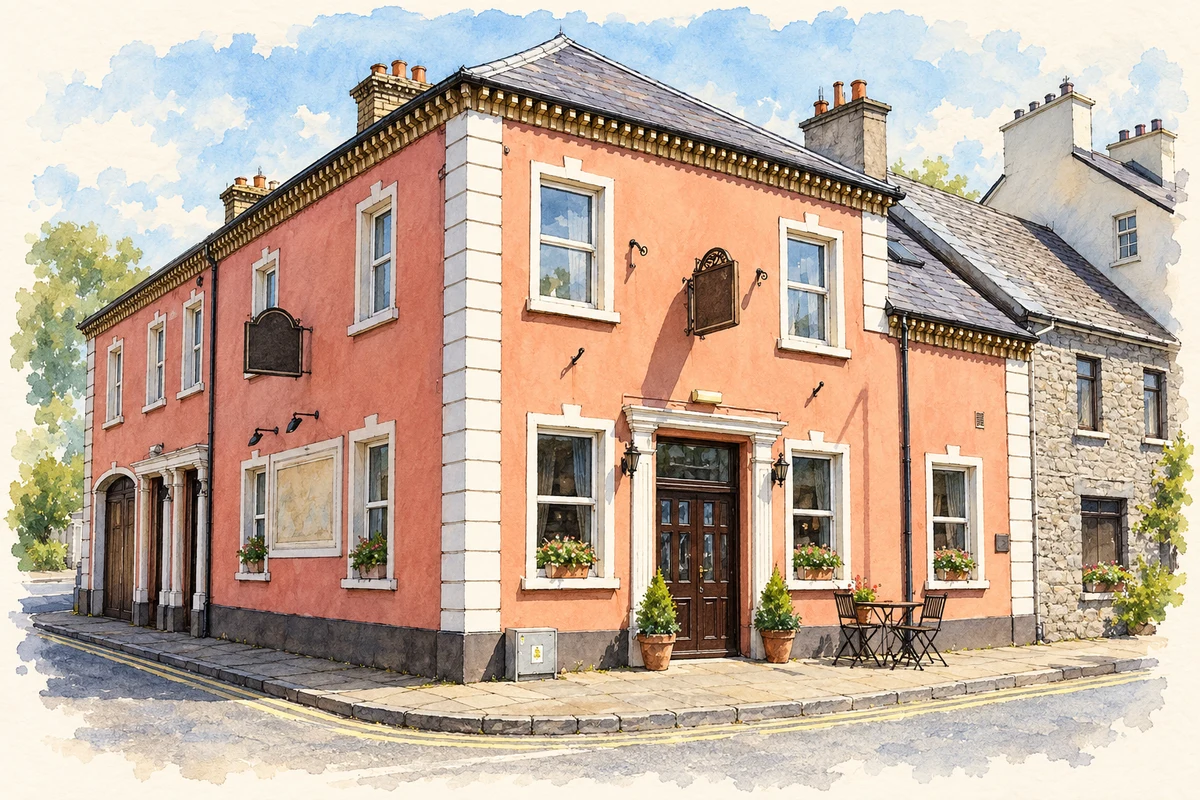
Courthouse Restaurant, Kinlough, County Leitrim illustration: based on a Courthouse Restaurant, Kinlough by Kenneth Allen. AI-assisted watercolour and ink adaptation; cream paper margins added, incidental clutter omitted and fine details simplified. Licence: CC BY-SA 2.0.
 placenames