A reliable full-name meaning has not been established here. The recorded Irish and English forms are given without an unsupported translation.
Recorded forms
Cluainín· Irish · main form · validated name
Manorhamilton· English · main form
Place & story
A street and its market square
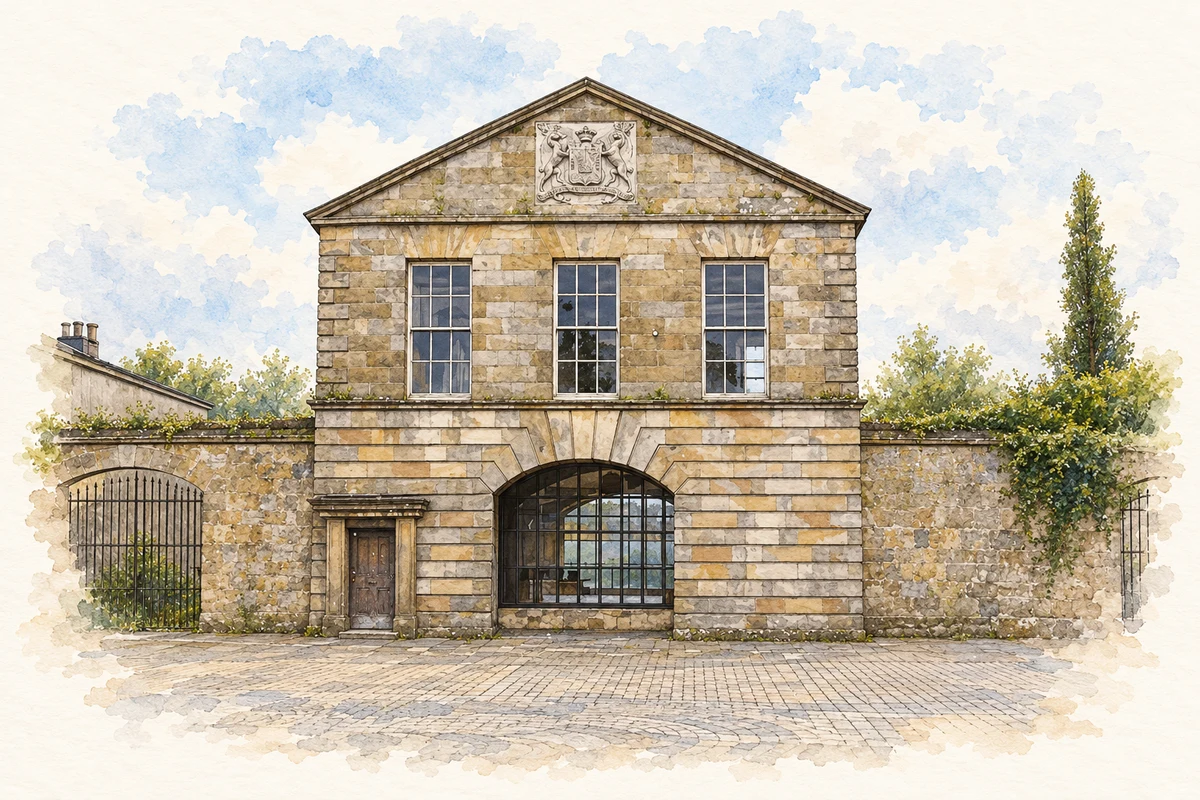
In 1837 the directory describes a long principal street, a market house and a square with buildings for provisions. Cattle fairs were among the town’s important activities. It also places Manorhamilton on the road from Enniskillen to Sligo. These details explain its function as a service and exchange centre for a wider rural district. The market drew people and animals through the town whose permanent homes lay elsewhere.[2]
People & connections
Frederick Hamilton's new settlement
Sir Frederick Hamilton received a substantial north Leitrim land grant in the seventeenth-century plantation and built his castle in 1634–36. The local heritage trail connects the town's early growth with this project: stone houses, mills, an inn and a Protestant church formed a small settlement beside the stronghold. Hamilton's name survives in the town, but the visible castle and surrounding streets represent a particular history of landholding and settlement rather than an ancient urban foundation. The castle's elevated position still makes that relationship easy to see.[3]
The later star fort
The town's defensive remains do not all belong to Hamilton's original building campaign. A modern archaeological assessment identifies the star-shaped fort overlooking Manorhamilton as eighteenth-century. It also notes the neat plots shown along the town's streets on the 1835 Ordnance Survey map. Different kinds of evidence therefore reveal different phases: the seventeenth-century castle, the later fort and the nineteenth-century mapped settlement. Their dates help explain how the town continued to develop after its founder's lifetime.[4]
Both counts use the 2016 settlement boundary, allowing like-for-like comparison. CSO supplies the 2022 count on this older boundary for comparison only. The official 2022 Built Up Area has different boundaries.
View population figures
Manorhamilton — Census 2016 settlement footprint — census population
Manorhamilton, Leitrim — Census town, CSO 2006 report
2002–2006: census town
1,158people · 2006
These are the historical areas published in the 2006 census report. Boundaries may differ between censuses and from modern settlements. Legal towns, environs and suburbs are shown separately; none has been combined into a modern settlement total.
View population figures
Manorhamilton, Leitrim — Census town, CSO 2006 report — census population
Manorhamilton, Leitrim — Census town, CSO 1996 report
1991–1996: census town
1,008people · 1996
These are the historical areas published in the 1996 census report. Boundaries may differ between censuses and from modern settlements. Legal towns, environs and suburbs are shown separately; none has been combined into a modern settlement total.
View population figures
Manorhamilton, Leitrim — Census town, CSO 1996 report — census population
Manorhamilton, Leitrim — Census town, CSO 1986 report
1981–1986: census town
1,031people · 1986
Figures cover the historical town area printed in the 1986 report. Boundaries may have changed between censuses. Legal town, environs and suburb totals remain separate and differ from modern settlement boundaries.
View population figures
Manorhamilton, Leitrim — Census town, CSO 1986 report — census population
These figures use different area definitions. Read the boundary note before comparing them.
Manorhamilton, Leitrim
Published census settlement populations
1,466people · 2016
Settlement boundaries changed during this period. Differences may reflect boundary changes as well as population change. Where a 2011 legal-town-and-environs count is shown, it has not been recalculated onto the 2016 settlement boundary.
Market House, Manorhamilton, County Leitrim illustration: based on a Market House, Manorhamilton by Kenneth Allen. AI-assisted watercolour and ink adaptation; cream paper margins added, incidental clutter omitted and fine details simplified. Licence: CC BY-SA 2.0.
 placenames