 placenames
Hollymount
Maolla
Hollymount’s estate-town history survives in its bridge, church remains and fairground traditions, even though the principal house has largely disappeared.
The name
These Irish name elements are associated with this record in the Logainm glossary.
An element’s translation is a clue, rather than a complete explanation of the name. Its form and meaning depend on local history and the full Irish name.
Recorded forms
- Maolla · Irish · main form · validated name
- Hollymount · English · main form
Place & story
The fairs and their changing trade
Sir Thomas Vesey received a patent for markets and fairs at Hollymount in 1734. Gerard Delaney’s local research traces the rights through the Lindsey estate and later into public ownership after the Land Commission acquired the property. The December fair supplied cattle, sheep and pigs for the Christmas trade, while the May fair became noted for hoggets. Railway transport later carried animals bought locally towards Dublin and the eastern grazing counties, linking a rural fairgreen to much wider livestock markets. [2]
The bridge over the Robe
Hollymount Bridge carries an 1840 date stone and spans the Robe in three segmental arches. Carefully finished limestone distinguishes the arch stones, rounded cutwaters and parapets. A benchmark on the stonework also connects the bridge with the Ordnance Survey’s mapping of the area. The architectural inventory records underpinning in 1852, a reminder that such crossings required maintenance as well as skilled initial construction. It remains a prominent piece of the village’s nineteenth-century engineering. [3]
Papworth’s rebuilding of Hollymount House
Archbishop John Vesey established an early eighteenth-century house at Hollymount. George Papworth later designed the rebuilding of 1834, apparently retaining parts of its predecessor. The architectural inventory describes a seven-bay residence with a central pedimented projection, subsequently associated with the Lindsey family. Vacated in 1922, it became derelict and eventually ruinous. A vaulted basement survived as a fragment of the house, while the walled garden and demesne bridge preserve other parts of an estate once central to the village. [4]
An iron spire conserved
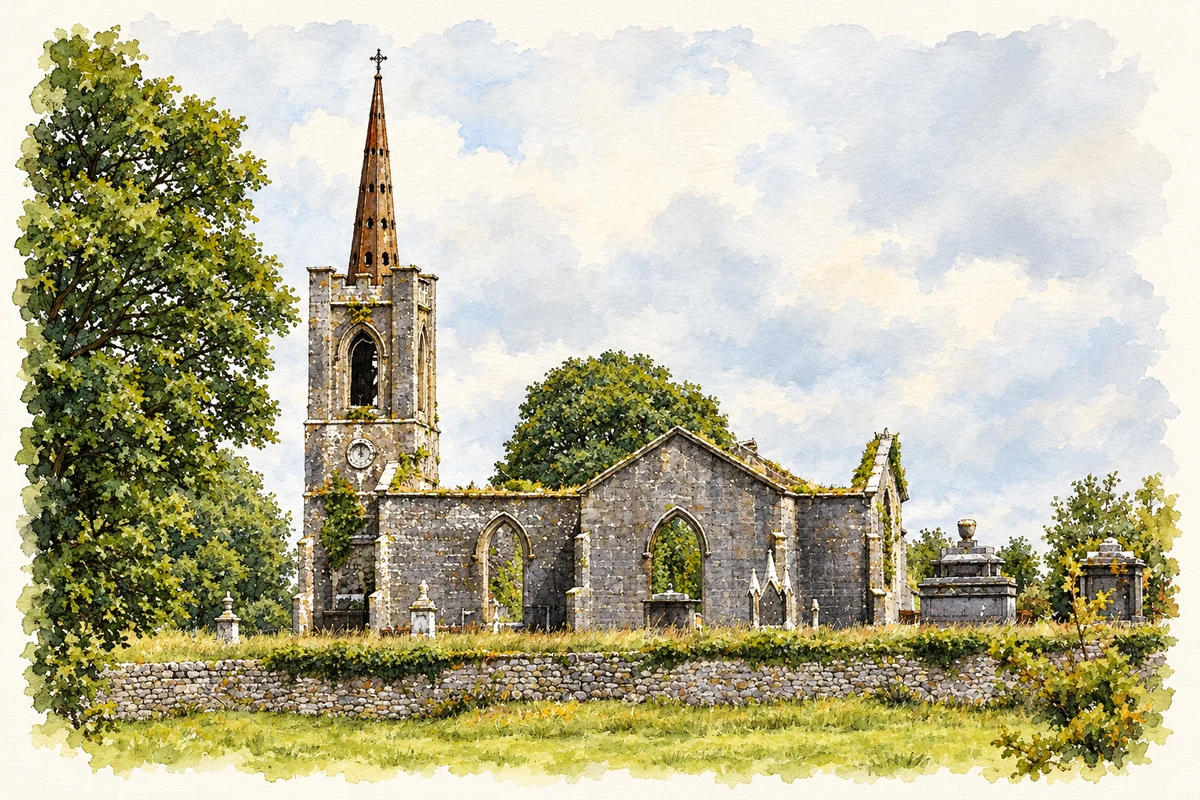
Hollymount’s Church of Ireland building dates from 1816. It closed in 1959 and later lost its roof, but retained an unusual cast-iron spire. The Irish Georgian Society supported stabilisation and repair through a grant in 2014. That project focused attention on a technically distinctive survivor within a ruined church. The spire records a different approach to ecclesiastical construction from the stone towers and spires more commonly encountered in Irish towns and villages. [5]
Geographic information
Sources & further reading
- Logainm.ie — Hollymount. Place names and geographic record, licensed under CC BY 4.0.
- Hollymount Fair Days · Gerard Delaney / South Mayo Family Research Centre
- Hollymount Bridge, record 31311028 · National Inventory of Architectural Heritage
- Hollymount House, record 31311022 · National Inventory of Architectural Heritage
- Hollymount church conservation project · Irish Georgian Society
- Surviving Church of Saint Charles the Martyr, Hollymount illustration: based on a Ruined church at Hollymount, Co. Mayo by Mike Searle. AI-assisted watercolour and ink adaptation; cream paper margins added, incidental clutter omitted and fine details simplified. Licence: CC BY-SA 2.0; adapted illustration distributed under the same licence.
Name record retrieved 2026-10-25 · Source record modified 2025-01-10. How this page was prepared.