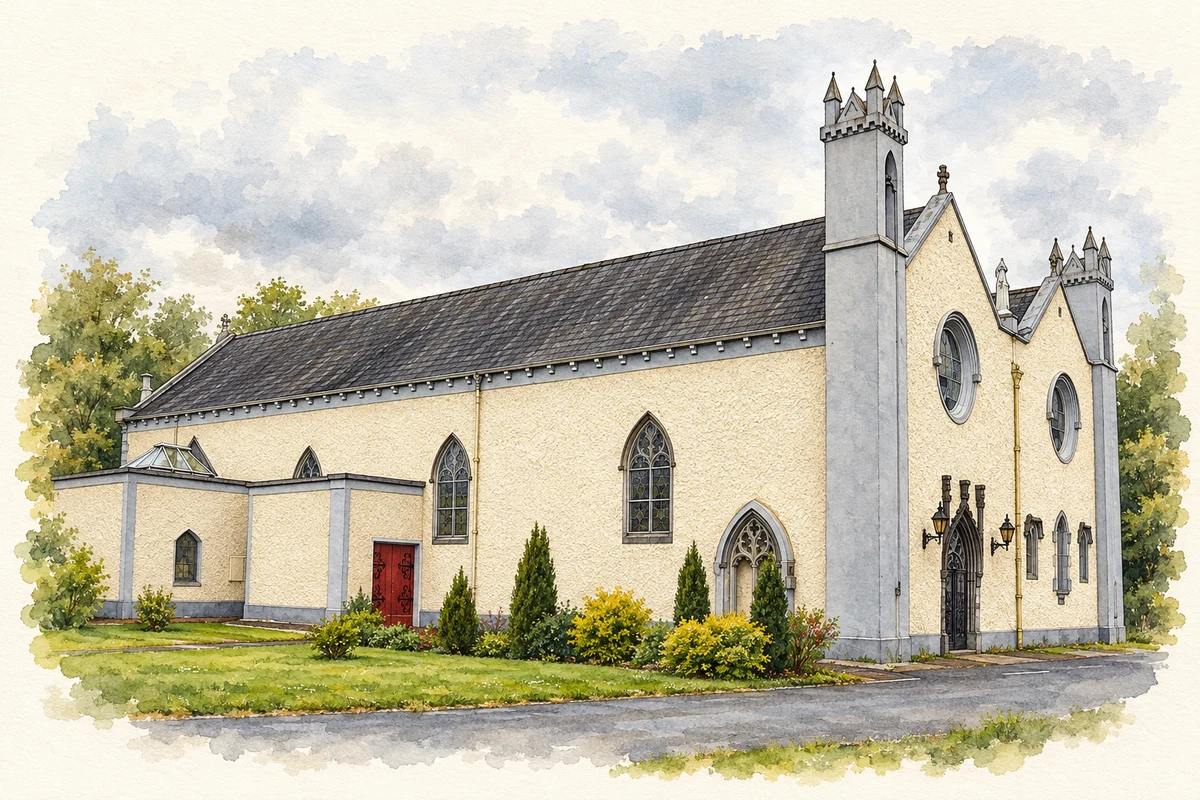
Ballyhaunis preserves a long Augustinian inheritance, with different foundation traditions and an unusually rich local archive gathered by Michael F. Waldron.
Illustration, St Mary's Friary Church, Ballyhaunis, County Mayo
⊕Recorded locationBallyhaunis53.76532° N · 8.77326° WInteractive map supplied by OpenStreetMap.
These Irish name elements are associated with this record in the Logainm glossary.
An element’s translation is a clue, rather than a complete explanation of the name. Its form and meaning depend on local history and the full Irish name.
Recorded forms
Béal Átha hAmhnais· Irish · main form · validated name
Ballyhaunis· English · main form
Place & story
When was the friary founded?
Ballyhaunis Friary is associated with a traditional foundation date of 1348, but the surviving documentary evidence points to a later medieval beginning. An archaeological assessment reproducing the monument record identifies a 1432 reference to Friar Philip Nangle in the Augustinian order's register. Historian F. X. Martin therefore suggested a foundation around 1430. Another tradition places the friary on a de Barry manor-house site, but the assessment notes that convincing evidence has not established that earlier building. These distinctions preserve the traditions without treating them as settled archaeological dates.[2]
People & connections
Local faces in Father Foran’s paintings
The friary church contains murals and Stations of the Cross painted by Father Edward A. Foran, prior from 1907 to 1914. The Abbey Trust records that he studied in Rome and used local people as models during his time in Ballyhaunis. His paintings connect the building's religious imagery with the surrounding community. The trust also preserves the story of the site's later stewardship: after the Augustinians left in 2002, the property passed under a long lease to Ballyhaunis Abbey Trust for continued community use.[3]
People & connections
Michael F. Waldron’s newspaper fragments
Michael F. Waldron assembled a substantial record of Ballyhaunis history through newspaper articles and scrapbooks. Mayo County Library has digitised the main scrapbook and an accompanying index prepared by Father Kieran Waldron. Michael studied privately before entering university, eventually receiving a doctorate in law in 1911. That year's census nevertheless described his occupation as teacher and journalist. His writings and local involvement, including work connected with the building of Saint Patrick's Church, make the archive a useful starting point for researching the town's people and institutions.[4]
Both counts use the 2016 settlement boundary, allowing like-for-like comparison. CSO supplies the 2022 count on this older boundary for comparison only. The official 2022 Built Up Area has different boundaries.
View population figures
Ballyhaunis — Census 2016 settlement footprint — census population
These are the historical areas published in the 2006 census report. Boundaries may differ between censuses and from modern settlements. Legal towns, environs and suburbs are shown separately; none has been combined into a modern settlement total.
View population figures
Ballyhaunis, Mayo — Census town, CSO 2006 report — census population
These are the historical areas published in the 1996 census report. Boundaries may differ between censuses and from modern settlements. Legal towns, environs and suburbs are shown separately; none has been combined into a modern settlement total.
View population figures
Ballyhaunis, Mayo — Census town, CSO 1996 report — census population
Figures cover the historical town area printed in the 1986 report. Boundaries may have changed between censuses. Legal town, environs and suburb totals remain separate and differ from modern settlement boundaries.
View population figures
Ballyhaunis, Mayo — Census town, CSO 1986 report — census population
These figures use different area definitions. Read the boundary note before comparing them.
Ballyhaunis, Mayo
Published census settlement populations
2,366people · 2016
Settlement boundaries changed during this period. Differences may reflect boundary changes as well as population change. Where a 2011 legal-town-and-environs count is shown, it has not been recalculated onto the 2016 settlement boundary.
St Mary's Friary Church, Ballyhaunis, County Mayo illustration: based on a BallyhaunisFriary by JohnArmagh. AI-assisted watercolour and ink adaptation; cream paper margins added, incidental clutter omitted and fine details simplified. Licence: CC BY-SA 3.0.
 placenames