These Irish name elements are associated with this record in the Logainm glossary.
An element’s translation is a clue, rather than a complete explanation of the name. Its form and meaning depend on local history and the full Irish name.
Recorded forms
An Mullach· Irish · main form · validated name
Mullagh· English · main form
Place & story
Folklore & tradition
The tradition of Kilian’s birthplace
Local tradition places Saint Kilian's birth at Cloghballybeg in Mullagh parish. The Dictionary of Irish Biography distinguishes that later association from the evidence for the missionary himself: Kilian worked in Würzburg and was martyred there in 689, but the early records do not establish a Mullagh birthplace. The distinction allows the tradition to be understood on its own terms. It is a longstanding local connection commemorated in the parish, rather than a securely documented detail of his seventh-century life.[2]
A heritage centre built through shared interest
Saint Kilian's Heritage Centre explores the saint's mission and the wider movement of Irish missionaries to continental Europe. The public libraries' Ask About Ireland record describes support from Germany alongside the International Fund for Ireland, local development funding and the community. Exhibits use maps, manuscript material and other displays to connect the two places. The centre also introduces the development of Irish writing, from ogham to manuscripts. Its existence gives Mullagh's remembered connection with Würzburg a tangible modern setting.[3]
The shape of an agricultural market town
Cavan County Council's village study identifies Mullagh's origins as a market centre serving surrounding farms. The wide main street, regular building frontages and long gardens behind them retain the form of a planned settlement. These details explain a different part of the village's history from the saint's tradition: the organisation of trade, houses and plots within a rural district. The council's comparison of maps from different periods shows how the older street pattern remains the framework around which later development has grown.[4]
Both counts use the 2016 settlement boundary, allowing like-for-like comparison. CSO supplies the 2022 count on this older boundary for comparison only. The official 2022 Built Up Area has different boundaries.
View population figures
Mullagh — Census 2016 settlement footprint — census population
These are the historical areas published in the 2006 census report. Boundaries may differ between censuses and from modern settlements. Legal towns, environs and suburbs are shown separately; none has been combined into a modern settlement total.
View population figures
Mullagh, Cavan — Census town, CSO 2006 report — census population
These are the historical areas published in the 1996 census report. Boundaries may differ between censuses and from modern settlements. Legal towns, environs and suburbs are shown separately; none has been combined into a modern settlement total.
View population figures
Mullagh, Cavan — Census town, CSO 1996 report — census population
Figures cover the historical town area printed in the 1986 report. Boundaries may have changed between censuses. Legal town, environs and suburb totals remain separate and differ from modern settlement boundaries.
View population figures
Mullagh, Cavan — Census town, CSO 1986 report — census population
These figures use different area definitions. Read the boundary note before comparing them.
Mullagh, Cavan
Published census settlement populations
1,348people · 2016
Settlement boundaries changed during this period. Differences may reflect boundary changes as well as population change. Where a 2011 legal-town-and-environs count is shown, it has not been recalculated onto the 2016 settlement boundary.
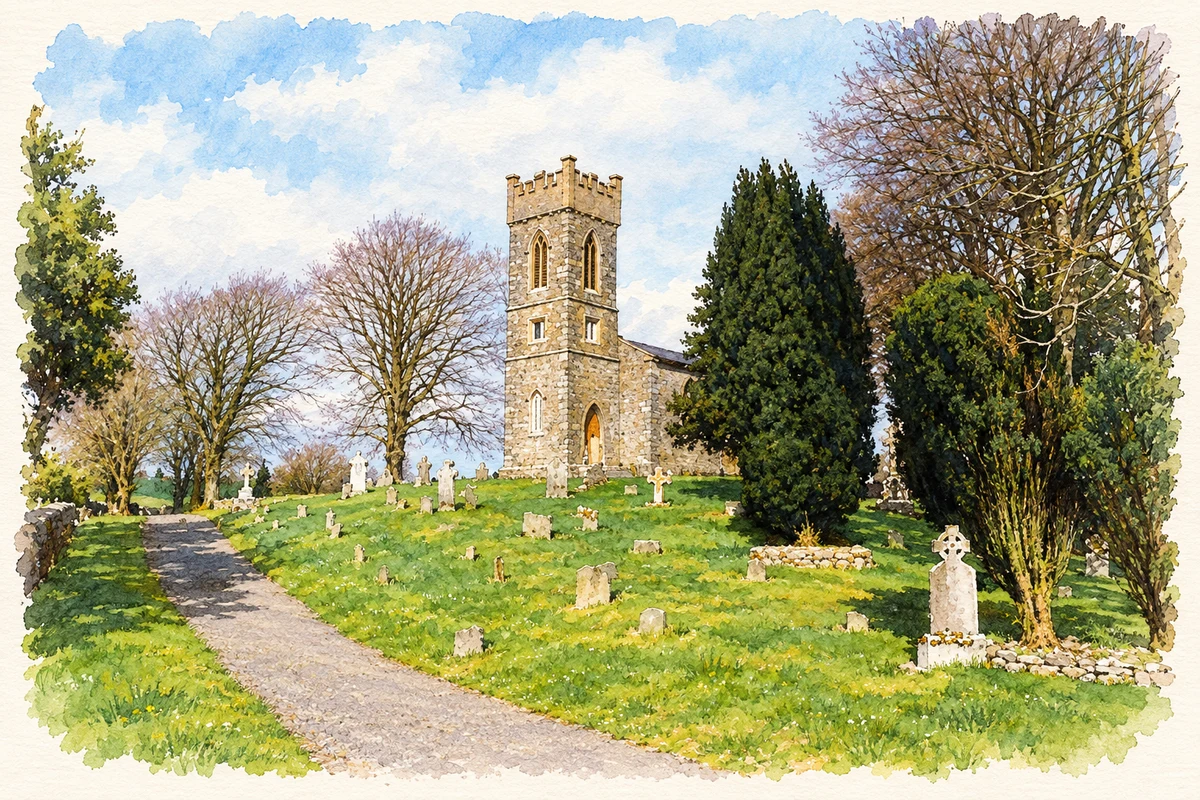
Church of Ireland and graveyard at Mullagh illustration: based on a Church and graveyard at Mullagh, Co. Cavan by Kieran Campbell. AI-assisted watercolour and ink adaptation; cream paper margins added, incidental clutter omitted and fine details simplified. Licence: CC BY-SA 2.0.
 placenames