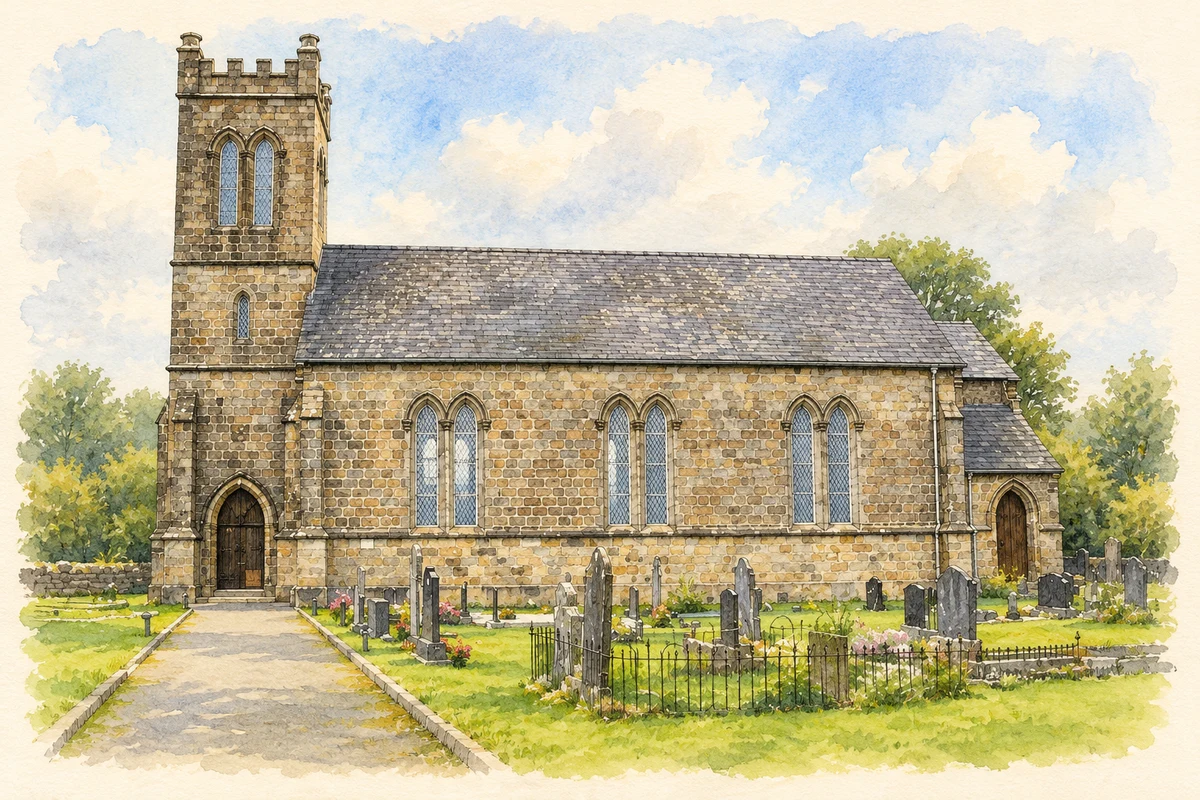
Swanlinbar's industrial name drew Jonathan Swift's mockery, while its mineral waters later attracted visitors to a landscaped spa beneath the Cuilcagh mountains.
Illustration, St Augustine's Church, Swanlinbar
⊕Recorded locationSwanlinbar54.19205° N · 7.70194° WInteractive map supplied by OpenStreetMap.
These Irish name elements are associated with this record in the Logainm glossary.
An element’s translation is a clue, rather than a complete explanation of the name. Its form and meaning depend on local history and the full Irish name.
Recorded forms
An Muileann Iarainn· Irish · main form · validated name
Swanlinbar· English · main form
Place & story
Four surnames in an ironworks name
Jonathan Swift discussed Swandlingbar in his essay On Barbarous Denominations in Ireland. He divided the name between four ironworks investors: Swift, Sanders, Darling and Barry. His account was openly mocking, describing their enterprise as a financial failure. It is a contemporary literary witness to an unusual business-derived place-name.[2]
A fire and the end of the furnaces
Samuel Lewis recorded that iron from nearby Cuilcagh was smelted in furnaces roughly half a mile from Swanlinbar and worked into bars using the power of the village stream. He attributed the industry's abandonment to the exhaustion of timber used in smelting. Another setback came in 1786, when an accidental fire destroyed twenty-two houses. By 1837 Lewis counted seventy-nine houses and 398 inhabitants, describing a place that had survived industrial decline and a substantial rebuilding after the fire.[3]
Breakfast at the pump-room
From April to September, Lewis reported, the spa attracted gentry from the surrounding district. Visitors walked through planted grounds and breakfasted in a pump-room beside the well, returning later for dinner. This social routine accompanied the belief that the mineral waters restored health. The spa therefore brought more than water-drinkers to Swanlinbar: it supported a seasonal meeting place, with meals, walks and company organised around the spring and its landscaped enclosure.[3]
Why the water smells of sulphur
The geological heritage inventory identifies the surviving Spa Well at Drumod Glebe, Swanlinbar, as a natural groundwater feature. Water enriched with sulphurous minerals rises from limestone where it encounters less permeable rock. The sulphur produces the characteristic strong smell. The inventory records the former belief that the water helped rheumatism and identifies Swanlinbar's earlier role as a spa town. This underlying geology helps explain the long-lived attraction that eighteenth- and nineteenth-century visitors found in the local springs.[4]
Both counts use the 2016 settlement boundary, allowing like-for-like comparison. CSO supplies the 2022 count on this older boundary for comparison only. The official 2022 Built Up Area has different boundaries.
View population figures
Swanlinbar — Census 2016 settlement footprint — census population
These are the historical areas published in the 2006 census report. Boundaries may differ between censuses and from modern settlements. Legal towns, environs and suburbs are shown separately; none has been combined into a modern settlement total.
View population figures
Swanlinbar, Cavan — Census town, CSO 2006 report — census population
These are the historical areas published in the 1996 census report. Boundaries may differ between censuses and from modern settlements. Legal towns, environs and suburbs are shown separately; none has been combined into a modern settlement total.
View population figures
Swanlinbar, Cavan — Census town, CSO 1996 report — census population
Figures cover the historical town area printed in the 1986 report. Boundaries may have changed between censuses. Legal town, environs and suburb totals remain separate and differ from modern settlement boundaries.
View population figures
Swanlinbar, Cavan — Census town, CSO 1986 report — census population
These figures use different area definitions. Read the boundary note before comparing them.
Swanlinbar, Cavan
Published census settlement populations
207people · 2016
Settlement boundaries changed during this period. Differences may reflect boundary changes as well as population change. Where a 2011 legal-town-and-environs count is shown, it has not been recalculated onto the 2016 settlement boundary.
 placenames