Arvagh's market house preserves the town's commercial and judicial past. Fair-day memories remain visible in local metalwork, while nearby Lacken was the birthplace of Peadar Cowan.
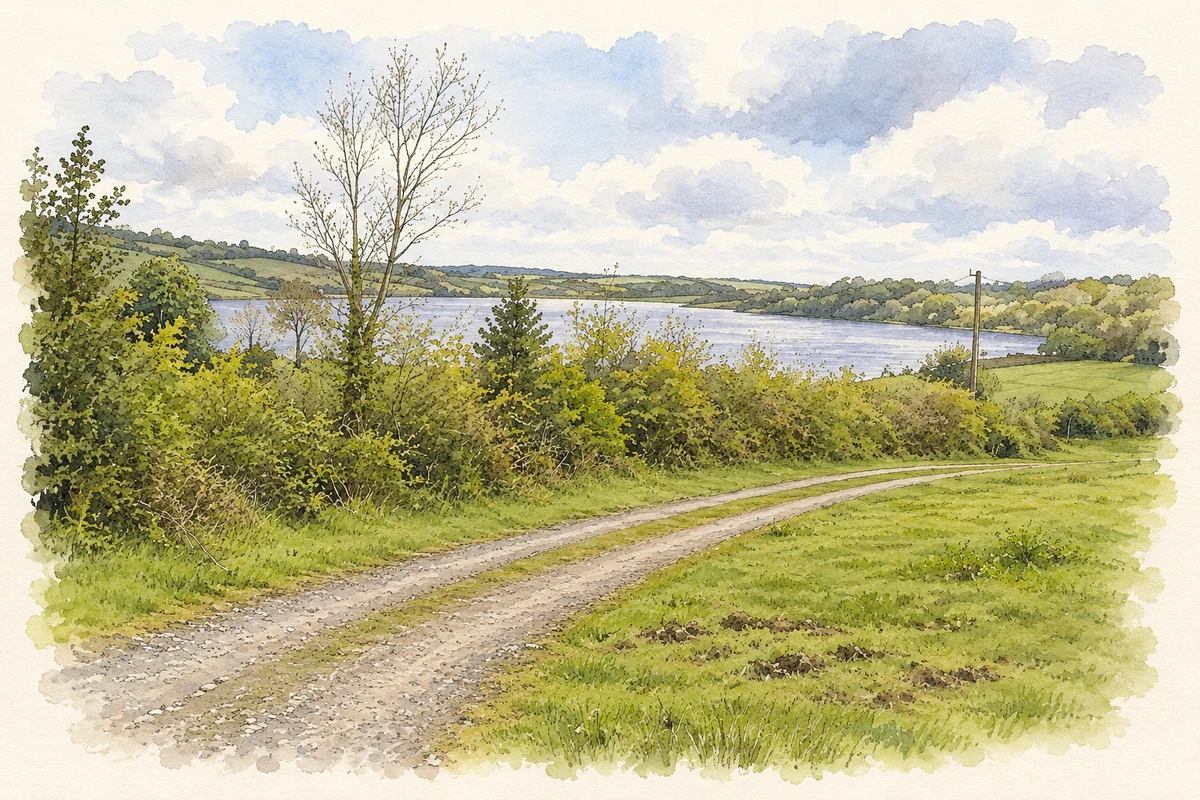
Illustration, Lower Lough, Arvagh
⊕Recorded locationArvagh53.92326° N · 7.58402° WInteractive map supplied by OpenStreetMap.
A reliable full-name meaning has not been established here. The recorded Irish and English forms are given without an unsupported translation.
Recorded forms
Ármhach· Irish · main form · validated name
Arvagh· English · main form
Arva· English · main form · local name
Place & story
Commerce below, justice above
Arvagh's market house was built around 1820 by the Earl of Gosford. The ground floor accommodated trading, while the upper floor served as a courthouse. Its nine-bay frontage has an imposing central pediment and carefully dressed limestone masonry. The design is attributed to W. D. Butler on architectural grounds. Later converted to a library, the building continued to host court business in part until 2008. The architectural survey also records surviving market scales and weights inside.[2]
A busy calendar of fairs
In 1837 Samuel Lewis counted 422 people in Arvagh town, distinguishing it from the surrounding parish's much larger population. The town stood near the meeting of Cavan, Leitrim and Longford. Its Friday market supplied provisions, while nine annual fairs brought further business, from a January gathering through to one just before Christmas. A constabulary station and the central market house formed part of this small commercial centre serving the neighbouring countryside.[3]
Fair-day memories in metal
The town's trading history inspired a more recent commission. Patrick Ellis asked metalworker Alfie Dennany to make gates for a yard that had held cattle during the old fairs. In a 2020 interview about the work, they explained how the steel-framed wooden gates were intended to represent that farming past. The commission gave the former fairground a visible reminder of its earlier purpose, connecting contemporary craftsmanship with the movement of livestock through Arvagh.[4]
People & connections
Peadar Cowan of Lacken
Peadar Cowan was born at Lacken, Arva, in 1903 and educated locally. His career took him from military service to law and national politics. A founding member of Clann na Poblachta, he won a Dáil seat for Dublin North East in 1948 and later sat as an independent. After imprisonment for misusing a client's money, he wrote Dungeons Deep in 1960, examining conditions in prisons and other institutions. He died in 1962.[5]
Both counts use the 2016 settlement boundary, allowing like-for-like comparison. CSO supplies the 2022 count on this older boundary for comparison only. The official 2022 Built Up Area has different boundaries.
View population figures
Arva — Census 2016 settlement footprint — census population
These are the historical areas published in the 2006 census report. Boundaries may differ between censuses and from modern settlements. Legal towns, environs and suburbs are shown separately; none has been combined into a modern settlement total.
View population figures
Arva, Cavan — Census town, CSO 2006 report — census population
These are the historical areas published in the 1996 census report. Boundaries may differ between censuses and from modern settlements. Legal towns, environs and suburbs are shown separately; none has been combined into a modern settlement total.
View population figures
Arva, Cavan — Census town, CSO 1996 report — census population
Figures cover the historical town area printed in the 1986 report. Boundaries may have changed between censuses. Legal town, environs and suburb totals remain separate and differ from modern settlement boundaries.
View population figures
Arva, Cavan — Census town, CSO 1986 report — census population
These figures use different area definitions. Read the boundary note before comparing them.
Arva, Cavan
Published census settlement populations
411people · 2016
Settlement boundaries changed during this period. Differences may reflect boundary changes as well as population change. Where a 2011 legal-town-and-environs count is shown, it has not been recalculated onto the 2016 settlement boundary.
 placenames