These Irish name elements are associated with this record in the Logainm glossary.
An element’s translation is a clue, rather than a complete explanation of the name. Its form and meaning depend on local history and the full Irish name.
Recorded forms
Béal Átha na nEach· Irish · main form · validated name
Bellananagh· English · main form
Ballinagh· English · main form · local name
Place & story
The burning of 1794
Ballinagh's history includes a destructive episode four years before the rebellion of 1798. The Cavan genealogy centre's county history records that militia burned the town in May 1794 while attempting to dislodge members of the Defenders. Samuel Lewis's 1837 dictionary also records the fire, describing a town subsequently rebuilt around two streets crossing at right angles. These sources place the destruction within the unrest of the 1790s, but do not justify attaching it to the later rebellion. The date matters when following local accounts or searching for contemporary references to the event.[2][3]
James Stewart Fleming’s market house
An inscription on the market house identifies James Stewart Fleming of Belville as its builder in 1821. The central portion is recessed beneath a broad roof, with arched openings below and small circular windows above. Space in front accommodated market activity and gave the building a prominent position in the town. The National Inventory of Architectural Heritage compares its design with Ballyjamesduff's market house and reports C. E. B. Brett's suggestion that the same architect was responsible. That resemblance is an architectural attribution, while Fleming's name and the date are recorded on the building itself.[4]
Markets, schools and parish boundaries
Lewis's pre-Famine account lists a Saturday market and five annual fairs, together with a constabulary station and fortnightly petty sessions. He describes a schoolhouse with boys taught downstairs and girls upstairs. His entry also places the town chiefly in Kilmore parish but partly in Ballintemple, with only three of its 135 houses in the latter in 1831. Those details are useful for understanding both everyday life and family research. A single street settlement could straddle an administrative boundary, so its familiar town name did not necessarily identify one parish record set.[3]
Both counts use the 2016 settlement boundary, allowing like-for-like comparison. CSO supplies the 2022 count on this older boundary for comparison only. The official 2022 Built Up Area has different boundaries.
View population figures
Ballinagh — Census 2016 settlement footprint — census population
These are the historical areas published in the 2006 census report. Boundaries may differ between censuses and from modern settlements. Legal towns, environs and suburbs are shown separately; none has been combined into a modern settlement total.
View population figures
Ballinagh, Cavan — Census town, CSO 2006 report — census population
These are the historical areas published in the 1996 census report. Boundaries may differ between censuses and from modern settlements. Legal towns, environs and suburbs are shown separately; none has been combined into a modern settlement total.
View population figures
Ballinagh, Cavan — Census town, CSO 1996 report — census population
Figures cover the historical town area printed in the 1986 report. Boundaries may have changed between censuses. Legal town, environs and suburb totals remain separate and differ from modern settlement boundaries.
View population figures
Ballinagh, Cavan — Census town, CSO 1986 report — census population
These figures use different area definitions. Read the boundary note before comparing them.
Ballinagh, Cavan
Published census settlement populations
936people · 2016
Settlement boundaries changed during this period. Differences may reflect boundary changes as well as population change. Where a 2011 legal-town-and-environs count is shown, it has not been recalculated onto the 2016 settlement boundary.
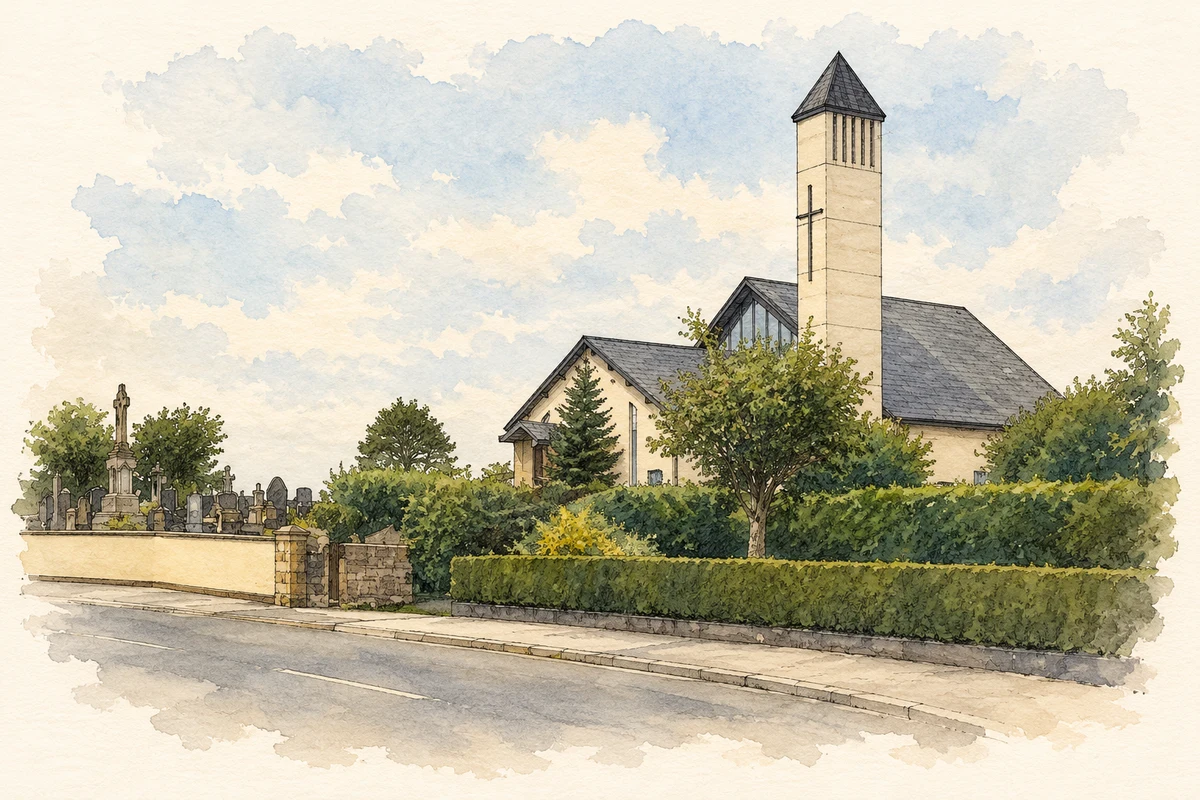
St Felim's Church, Ballinagh (Bellananagh) illustration: based on a St Felim's Church, Ballinagh by Eric Jones. AI-assisted watercolour and ink adaptation; cream paper margins added, incidental clutter omitted and fine details simplified. Licence: CC BY-SA 2.0.
 placenames