A reliable full-name meaning has not been established here. The recorded Irish and English forms are given without an unsupported translation.
Recorded forms
Baile Easa Dara· Irish · main form · validated name
Ballysadare· English · main form
Ballisodare· English · main form · local name
Place & story
Waterpower beside the tide
Samuel Lewis's 1837 dictionary describes Ballysadare's waterfalls as a dependable source of power for several mills. He names corn mills run by Sim and Culbertson, the latter newly built in 1835, alongside smaller mills and a bleaching business. Ships carried corn and meal out through the channel. Lewis also recorded the monastery remains above the falls and their association with Saint Fechin. His account places religious remains, industry and coastal trade within the same compact river landscape, rather than treating the village solely as a literary setting.[2]
People & connections
A fragment heard in Ballisodare
In a note to Down by the Salley Gardens, Yeats explained that the poem grew from three lines he heard sung by an elderly woman at Ballisodare, an alternative spelling of Ballysadare. He described his poem as an extension of that fragment. The note establishes a particular local encounter behind a widely known work, but does not identify the singer or locate a precise garden. A named garden, house or biographical story for the woman would go beyond the evidence Yeats supplied.[3]
Folklore & tradition
Paddy Flynn and the banshee by the river
Yeats's Celtic Twilight introduces Paddy Flynn as a storyteller living in a one-room cabin at Ballisodare. In Yeats's account, Flynn considered it an especially fairy-haunted place and said he had seen a banshee beating the river with her hands. Yeats presented these recollections as material copied from a notebook of Flynn's tales and sayings. They preserve a named storyteller's reported beliefs through a literary collector's voice. The banshee belongs to that recorded folklore, rather than to an independently verified event beside the falls.[4]
Both counts use the 2016 settlement boundary, allowing like-for-like comparison. CSO supplies the 2022 count on this older boundary for comparison only. The official 2022 Built Up Area has different boundaries.
View population figures
Ballisodare — Census 2016 settlement footprint — census population
These are the historical areas published in the 2006 census report. Boundaries may differ between censuses and from modern settlements. Legal towns, environs and suburbs are shown separately; none has been combined into a modern settlement total.
View population figures
Ballisodare, Sligo — Census town, CSO 2006 report — census population
These are the historical areas published in the 1996 census report. Boundaries may differ between censuses and from modern settlements. Legal towns, environs and suburbs are shown separately; none has been combined into a modern settlement total.
View population figures
Ballisodare, Sligo — Census town, CSO 1996 report — census population
Figures cover the historical town area printed in the 1986 report. Boundaries may have changed between censuses. Legal town, environs and suburb totals remain separate and differ from modern settlement boundaries.
View population figures
Ballisodare, Sligo — Census town, CSO 1986 report — census population
These figures use different area definitions. Read the boundary note before comparing them.
Ballisodare, Sligo
Published census settlement populations
1,350people · 2016
Settlement boundaries changed during this period. Differences may reflect boundary changes as well as population change. Where a 2011 legal-town-and-environs count is shown, it has not been recalculated onto the 2016 settlement boundary.
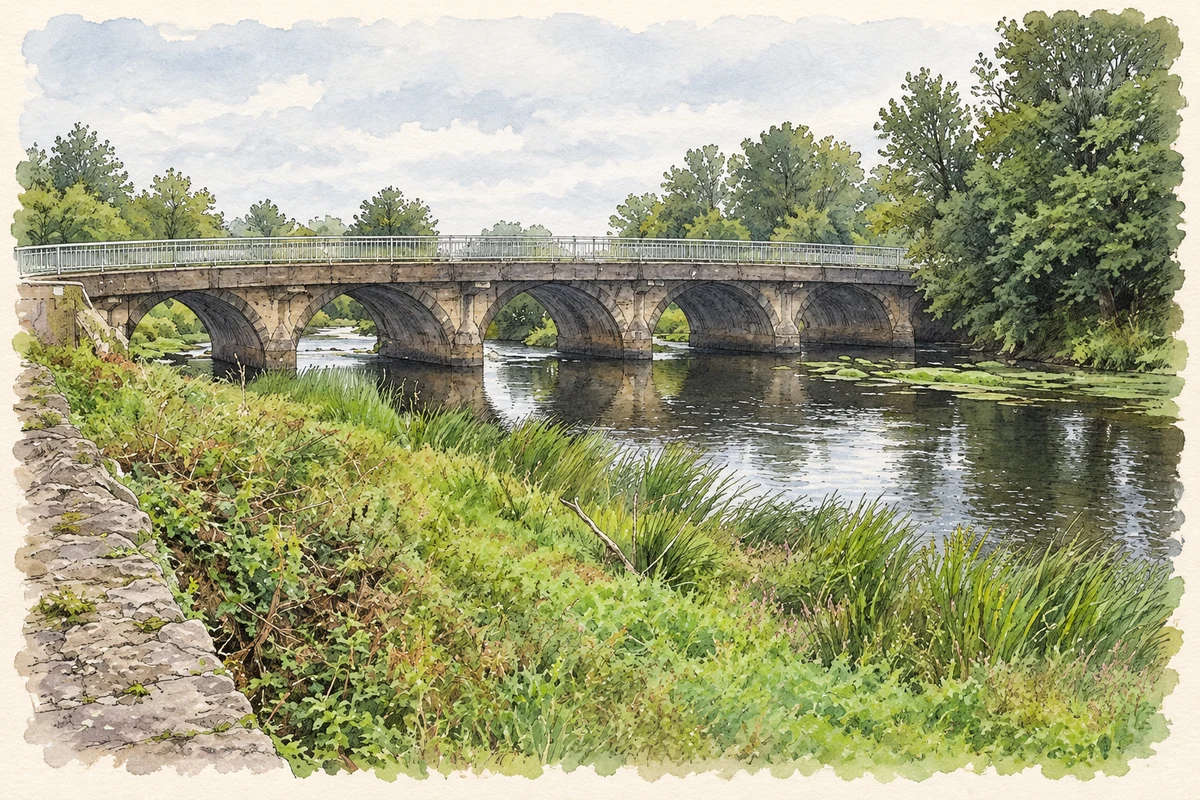
Ballysadare Bridge and river illustration: based on a Ballysadare Bridge by Anne Burgess. AI-assisted watercolour and ink adaptation; cream paper margins added, incidental clutter omitted and fine details simplified. Licence: CC BY-SA 2.0.
 placenames