Bansha became closely associated with rural development through Canon John Hayes. Its switch-on ceremony and jam factory made the village a practical demonstration of community organisation in post-war Ireland.
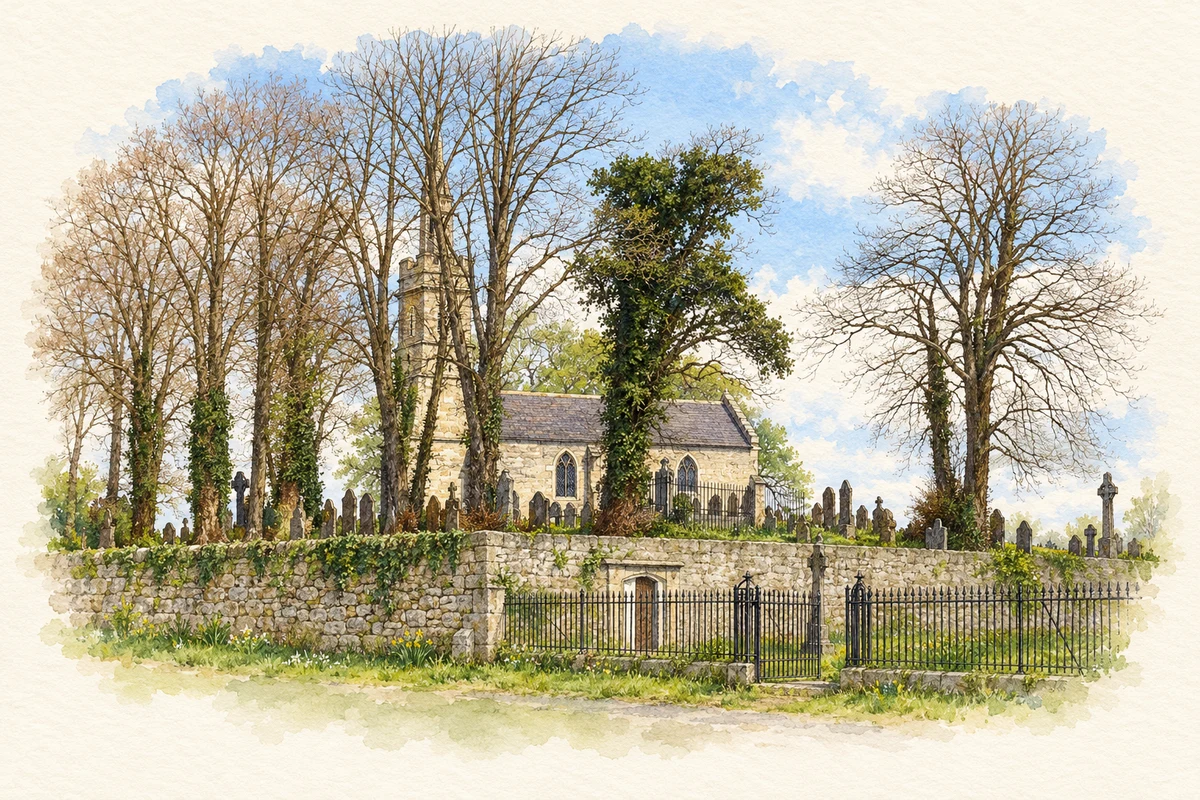
Illustration, Bansha church and graveyard
⊕Recorded locationBansha52.44525° N · 8.06859° WInteractive map supplied by OpenStreetMap.
A reliable full-name meaning has not been established here. The recorded Irish and English forms are given without an unsupported translation.
Recorded forms
An Bháinseach· Irish · main form · validated name
Bansha· English · main form
Place & story
People & connections
Canon Hayes and local organisation
John Martin Hayes established Muintir na Tíre as a national community-development movement in 1937, with its first unit in Tipperary town. He became parish priest of Bansha and Kilmoyler in 1946 and remained until his death in 1957. The movement encouraged residents to organise improvements in their own communities, encompassing social, economic, cultural and recreational life. His local standing is remembered in Canon Hayes Park, the Galtee Rovers grounds, named for him as a former patron of the club.[2][3]
Electricity recorded on radio
Bansha's electrification in 1948 became the subject of a Radio Éireann feature broadcast on 27 January 1949. Produced with the ESB's Rural Electrification Office, the programme followed the process of bringing power to the parish and explained its intended benefits for homes, farming, healthcare and industry. It combined reconstructed scenes with a recording of Hayes addressing the switch-on crowd and a band playing. The surviving broadcast preserves the public occasion and the arguments used to encourage households to accept an unfamiliar technology.[4]
Jam from the old mill
A contemporary report in the ESB's November 1948 newsletter described a new factory at Bansha producing jam, jelly, custard powder and other goods. It occupied a formerly derelict building and drew on locally organised enterprise, with products packed in boxes made for the business. Industry and commerce minister Dan Morrissey performed the opening. The report noted that some women had returned from abroad to work there. The factory linked the arrival of electricity with an attempt to provide employment and reduce the need for young people to emigrate.[5]
Templeneiry's tower and spire
The former Church of Ireland church at Templeneiry records an earlier layer of Bansha's history. Built in 1718 and substantially renovated in 1793–94, it received its tower's octagonal upper stage and spire in 1814. Carved details, battlements and diagonal buttresses give the small church a conspicuous profile above its historic graveyard. The architectural inventory records its later use as a community centre, extending the public life of a building originally intended for worship.[6]
Both counts use the 2016 settlement boundary, allowing like-for-like comparison. CSO supplies the 2022 count on this older boundary for comparison only. The official 2022 Built Up Area has different boundaries.
View population figures
Bansha — Census 2016 settlement footprint — census population
Bansha, South Tipperary — Census town, CSO 2006 report
2002–2006: census town
272people · 2006
These are the historical areas published in the 2006 census report. Boundaries may differ between censuses and from modern settlements. Legal towns, environs and suburbs are shown separately; none has been combined into a modern settlement total.
View population figures
Bansha, South Tipperary — Census town, CSO 2006 report — census population
Bansha, South Tipperary — Census town, CSO 1996 report
1991–1996: census town
288people · 1996
These are the historical areas published in the 1996 census report. Boundaries may differ between censuses and from modern settlements. Legal towns, environs and suburbs are shown separately; none has been combined into a modern settlement total.
View population figures
Bansha, South Tipperary — Census town, CSO 1996 report — census population
Figures cover the historical town area printed in the 1986 report. Boundaries may have changed between censuses. Legal town, environs and suburb totals remain separate and differ from modern settlement boundaries.
View population figures
Bansha, Tipperary — Census town, CSO 1986 report — census population
These figures use different area definitions. Read the boundary note before comparing them.
Bansha, South Tipperary
Published census settlement populations
333people · 2016
Settlement boundaries changed during this period. Differences may reflect boundary changes as well as population change. Where a 2011 legal-town-and-environs count is shown, it has not been recalculated onto the 2016 settlement boundary.
 placenames