 placenames
Bunmahon
Bun Machan
Bunmahon’s nineteenth-century copper industry left engine houses, ore-handling remains and the stories of people whose lives followed the mines.
The name
These Irish name elements are associated with this record in the Logainm glossary.
An element’s translation is a clue, rather than a complete explanation of the name. Its form and meaning depend on local history and the full Irish name.
Recorded forms
- Bun Machan · Irish · main form · validated name
- Bunmahon · English · main form
- Bonmahon · English · main form · local name
Place & story
A mining settlement grows
The Mining Company of Ireland developed the Knockmahon mines beside Bunmahon during the 1820s and 1830s. Expensive workings eventually extended deep underground and beneath the seabed. As Knockmahon became increasingly difficult to work, the company transferred its main operation east to Tankardstown from 1850. The last ore sales there were made in 1879. The contraction prompted many mining families to leave, with some finding work in American copper districts, including Butte, Montana. [2]
The ore’s route to the sea
Stage Cove preserves remains of the copper storage yard and shipping infrastructure used to send ore to Swansea. A mineral tramway connected Tankardstown with the dressing floors at Bunmahon. The Cornish engine houses at Tankardstown, east of the village, were built around 1860 to raise ore and pump water from the workings. These sites represent different parts of one industrial system: extraction, processing and export. [2]
John Petherick’s local work
Cornish mining engineer John Petherick lived in Bunmahon for about twenty-five years and managed its mines for roughly twenty of them. Historian Des Cowman records his efforts to establish schooling at Knockmahon, contribute to a nearby Catholic church and secure a district hospital during the Famine. He also supported repeal of the Act of Union. His local career therefore extended beyond engineering into education, relief and politics. [3]
Mary Petherick and the Temperance Hall
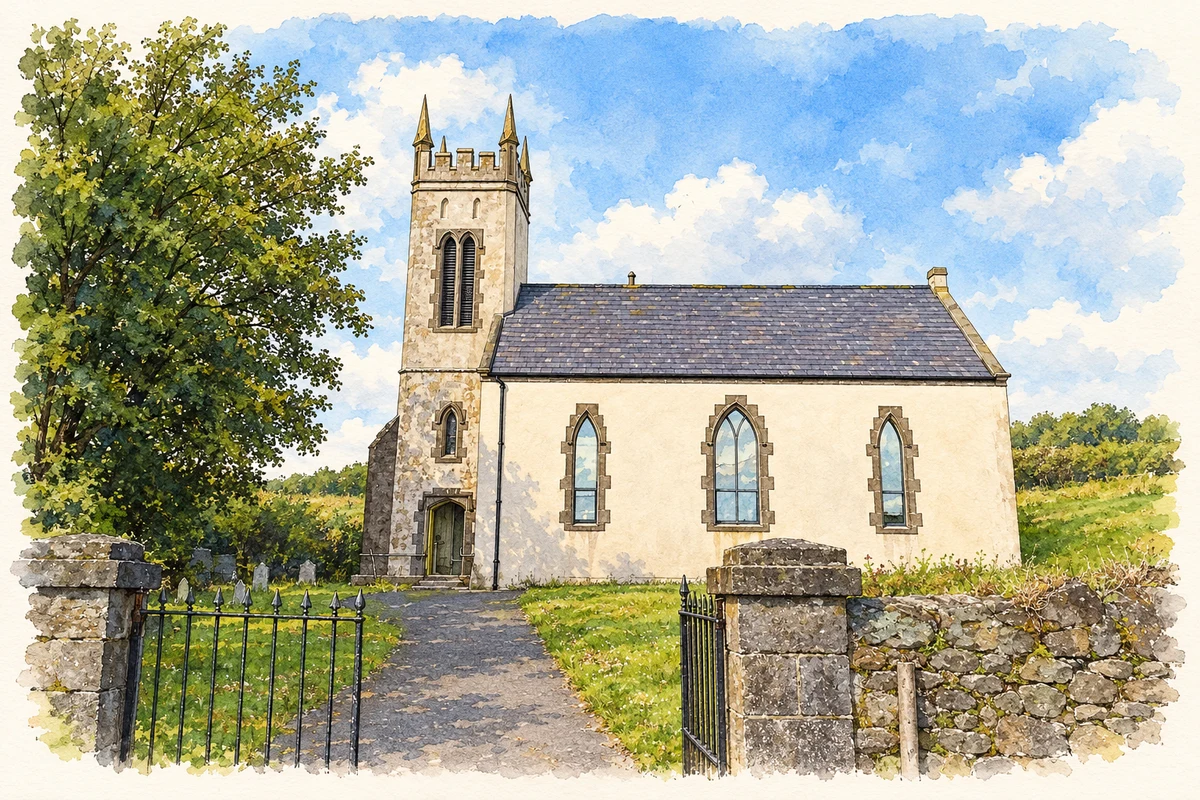
Mary Petherick, née Hooper, helped organise the opening of the miners' Temperance Hall. Cowman's account records her insistence that the miners should have a celebration of their own, with tea and food provided for hundreds of workers. The hall subsequently became a church. This change of use preserves a link between the mining community's social institutions and the later religious life of the village. [3]
Geographic information
- Place type
- Population centre
- County
- Waterford
- Barony
- Decies-without-Drum
- Civil parish
- Ballylaneen
- Civil parish
- Kilbarrymeaden
- Civil parish
- Monksland
- Coordinates
- 52.13950, -7.36777
- Logainm ID
- 49054 ↗
Sources & further reading
- Logainm.ie — Bunmahon. Place names and geographic record, licensed under CC BY 4.0.
- Mining Heritage of the Copper Coast · Copper Coast UNESCO Global Geopark
- John Petherick (1803–1877): the radicalism of a visionary mine manager, Copper Coast Connects 2A1 (2022) · Des Cowman, Copper Coast UNESCO Global Geopark
- Copper Coast Geopark Visitor Centre, Bunmahon, County Waterford illustration: based on a Knockmahon Church 2 by A.-K. D.. AI-assisted watercolour and ink adaptation; cream paper margins added, incidental clutter omitted and fine details simplified. Licence: CC BY-SA 4.0.

Name record retrieved 2026-10-25 · Source record modified 2026-06-17. How this page was prepared.