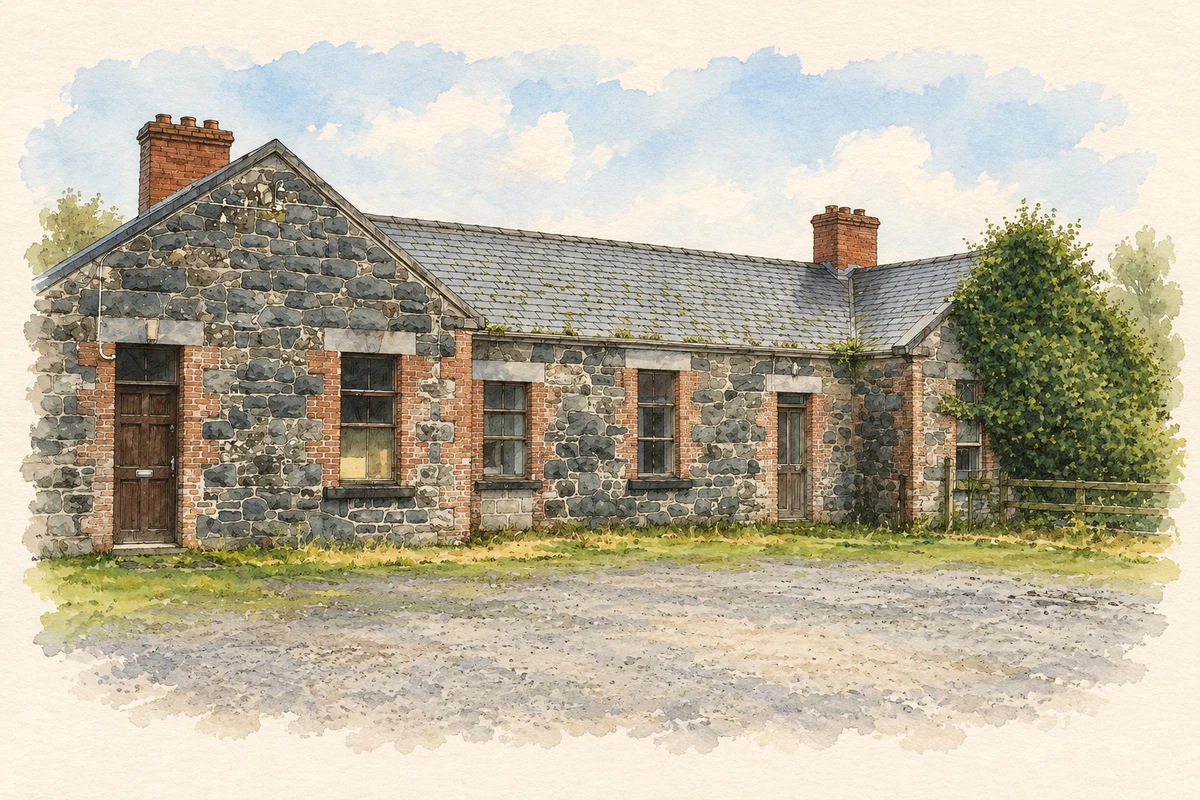
Killashandra, commonly written Killeshandra, combines the history of a prosperous linen market with an unusual seventeenth-century church preserved by local conservation work.
Illustration, former Killeshandra railway station — as photographed in 2011
⊕Recorded locationKillashandra54.00977° N · 7.52626° WInteractive map supplied by OpenStreetMap.
These Irish name elements are associated with this record in the Logainm glossary.
An element’s translation is a clue, rather than a complete explanation of the name. Its form and meaning depend on local history and the full Irish name.
Recorded forms
Cill na Seanrátha· Irish · main form · validated name
Killashandra· English · main form
Killeshandra· English · main form · local name
Place & story
A market town among the lakes
Samuel Lewis described Killeshandra in 1837 as a well-built town near the Croghan River, with about two hundred houses. Linen manufacture in the surrounding district supported a substantial weekly market, alongside fairs and a provision market held on Wednesdays. The town's market house, courts and constabulary station made it a service centre for a much wider area. Lewis's reported 1,137 inhabitants belonged to the town; his much larger total included the wider parish and associated districts. The linen trade connected domestic production in the countryside with the commercial life of the town.[2]
The Church of the Rath
The Church of the Rath occupies a site with medieval religious origins. The Heritage Council records a late-seventeenth-century rebuilding by the Hamilton family, whose surviving carved windows give the church its distinctive Renaissance character. A replacement Anglican church opened in 1841, after which the older building declined. Its significance lies partly in that unusual surviving fabric: a small church preserving architectural ambitions associated with the Restoration period, within a much older place of burial and worship.[3]
Saving the vaulted ceiling
Killeshandra Tidy Towns adopted the old church through the Heritage Council's Adopt a Monument scheme. Concern about water entering the roof led to specialist advice and a protective zinc covering intended to safeguard the barrel-vaulted ceiling. Local events brought the graveyard's history to wider audiences, and workshops with historic-brick specialists explored the building's materials. Conservation here has involved both the physical fabric and the community's knowledge of the site.[3]
Both counts use the 2016 settlement boundary, allowing like-for-like comparison. CSO supplies the 2022 count on this older boundary for comparison only. The official 2022 Built Up Area has different boundaries.
View population figures
Killeshandra — Census 2016 settlement footprint — census population
Killeshandra, Cavan — Census town, CSO 2006 report
2002–2006: census town
411people · 2006
These are the historical areas published in the 2006 census report. Boundaries may differ between censuses and from modern settlements. Legal towns, environs and suburbs are shown separately; none has been combined into a modern settlement total.
View population figures
Killeshandra, Cavan — Census town, CSO 2006 report — census population
Killeshandra, Cavan — Census town, CSO 1996 report
1991–1996: census town
427people · 1996
These are the historical areas published in the 1996 census report. Boundaries may differ between censuses and from modern settlements. Legal towns, environs and suburbs are shown separately; none has been combined into a modern settlement total.
View population figures
Killeshandra, Cavan — Census town, CSO 1996 report — census population
Killeshandra, Cavan — Census town, CSO 1986 report
1981–1986: census town
455people · 1986
Figures cover the historical town area printed in the 1986 report. Boundaries may have changed between censuses. Legal town, environs and suburb totals remain separate and differ from modern settlement boundaries.
View population figures
Killeshandra, Cavan — Census town, CSO 1986 report — census population
These figures use different area definitions. Read the boundary note before comparing them.
Killeshandra, Cavan
Published census settlement populations
388people · 2016
Settlement boundaries changed during this period. Differences may reflect boundary changes as well as population change. Where a 2011 legal-town-and-environs count is shown, it has not been recalculated onto the 2016 settlement boundary.
 placenames