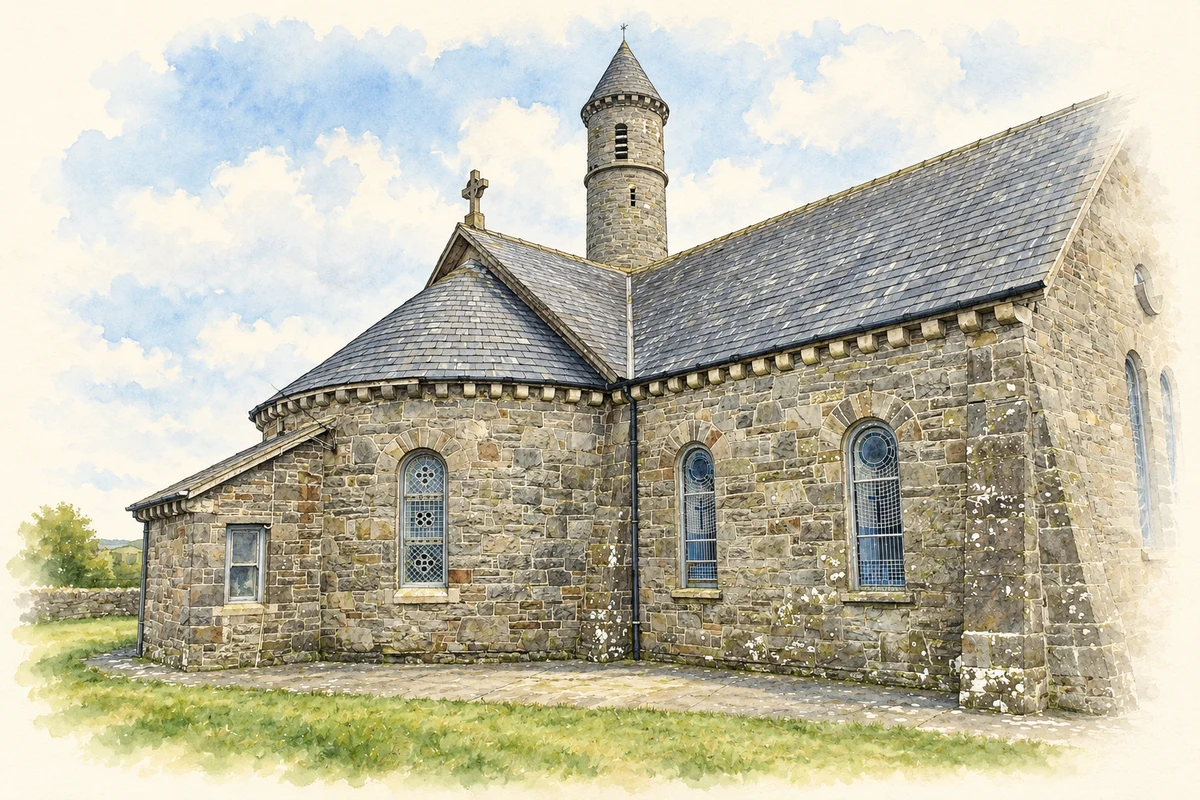
Quilty's church commemorates the rescue of French sailors in 1907, while local testimony records the seaweed trade that helped sustain its farming and fishing families.
Illustration, Quilty church, side view
⊕Recorded locationQuilty52.81516° N · 9.45681° WInteractive map supplied by OpenStreetMap.
These Irish name elements are associated with this record in the Logainm glossary.
An element’s translation is a clue, rather than a complete explanation of the name. Its form and meaning depend on local history and the full Irish name.
Recorded forms
Coillte· Irish · main form · validated name
Quilty· English · main form
Place & story
The wreck of the Léon XIII
In autumn 1907 the French sailing ship Léon XIII reached Queenstown after a voyage from Portland, Oregon, carrying wheat. Ordered onwards to Limerick for Bannatyne's mill, she encountered a violent storm and lost her rudder off the Clare coast. The ship was sighted off Quilty on 1 October and broke against the reefs. Local fishermen's rescue efforts became the defining event commemorated in the village. Former Quilty school principal Mick Carrick's historical account identifies the ship's Nantes construction in 1902 and its crew of twenty-two, linking the local rescue with a much longer ocean voyage.[2]
A church built by gifts and labour
Richard Haren donated the site for Quilty's church, while a Limerick architect named Burke supplied his services without charge. Local people contributed labour, sand and stone. The church opened on 9 October 1911 as Stella Maris, Our Lady Star of the Sea. Its Hiberno-Romanesque design includes a round tower with a conical stone roof, an apse and round-headed windows. The bell from the Léon XIII was presented to the church in 1949, giving the congregation a tangible object from the ship whose rescue had helped inspire the building campaign.[3][5]
Michael Falsey's memories of the seaweed trade
Interviewed in 2000, Quilty resident Michael Falsey recalled families supplementing small farms with the harvest of seaweed. Carrageen was dried and bleached on the sandhills before sale, while winter storms supplied seaweed stalks that were bundled and dried. Carts brought these materials to Quilty's West Clare Railway station for transport to processing factories. In summer, kelp was burned in stone-lined trenches; the hardened ash was broken up and bagged. His account records skilled seasonal work and the link between the shore, household income and the railway.[4]
Both counts use the 2016 settlement boundary, allowing like-for-like comparison. CSO supplies the 2022 count on this older boundary for comparison only. The official 2022 Built Up Area has different boundaries.
View population figures
Quilty — Census 2016 settlement footprint — census population
These are the historical areas published in the 2006 census report. Boundaries may differ between censuses and from modern settlements. Legal towns, environs and suburbs are shown separately; none has been combined into a modern settlement total.
View population figures
Quilty, Clare — Census town, CSO 2006 report — census population
These are the historical areas published in the 1996 census report. Boundaries may differ between censuses and from modern settlements. Legal towns, environs and suburbs are shown separately; none has been combined into a modern settlement total.
View population figures
Quilty, Clare — Census town, CSO 1996 report — census population
Figures cover the historical town area printed in the 1986 report. Boundaries may have changed between censuses. Legal town, environs and suburb totals remain separate and differ from modern settlement boundaries.
View population figures
Quilty, Clare — Census town, CSO 1986 report — census population
These figures use different area definitions. Read the boundary note before comparing them.
Quilty, Clare
Published census settlement populations
173people · 2016
Settlement boundaries changed during this period. Differences may reflect boundary changes as well as population change. Where a 2011 legal-town-and-environs count is shown, it has not been recalculated onto the 2016 settlement boundary.
 placenames