These Irish name elements are associated with this record in the Logainm glossary.
An element’s translation is a clue, rather than a complete explanation of the name. Its form and meaning depend on local history and the full Irish name.
Recorded forms
Inis Eonáin· Irish · main form · validated name
Innishannon· English · main form
Inishannon· English · main form · local name
Place & story
People & connections
Thomas Adderley's textile village
Thomas Adderley, who lived from 1712 to 1791, combined politics and estate ownership with the development of linen manufacture at Innishannon. His family held land around the village, and his industrial activity helped shape its eighteenth-century history. Later generations inherited a more troubled financial position. The University of Galway's estate history records that his son Edward Hale Adderley became heavily indebted and sold the property to the Frewen family before Griffith's Valuation. The village's estate history therefore includes both an ambitious manufacturing venture and a subsequent change of ownership.[2]
Elisabeth Cortey and the silkworms
A letter Adderley wrote in April 1755 described the linen enterprise and the Protestant settlers living under his patronage at Innishannon. Silk production followed alongside the better-known linen work. In January 1766 the Dublin Society awarded Elisabeth Cortey £22 15s for cocoons and raw silk produced from silkworms she had raised. It also sought terms on which she would teach others the process. Adderley received a gold medal for planting white mulberry trees. These recorded awards identify both the practical knowledge of a local woman and the agricultural experiment supporting the industry.[3]
Christ Church's limestone spire
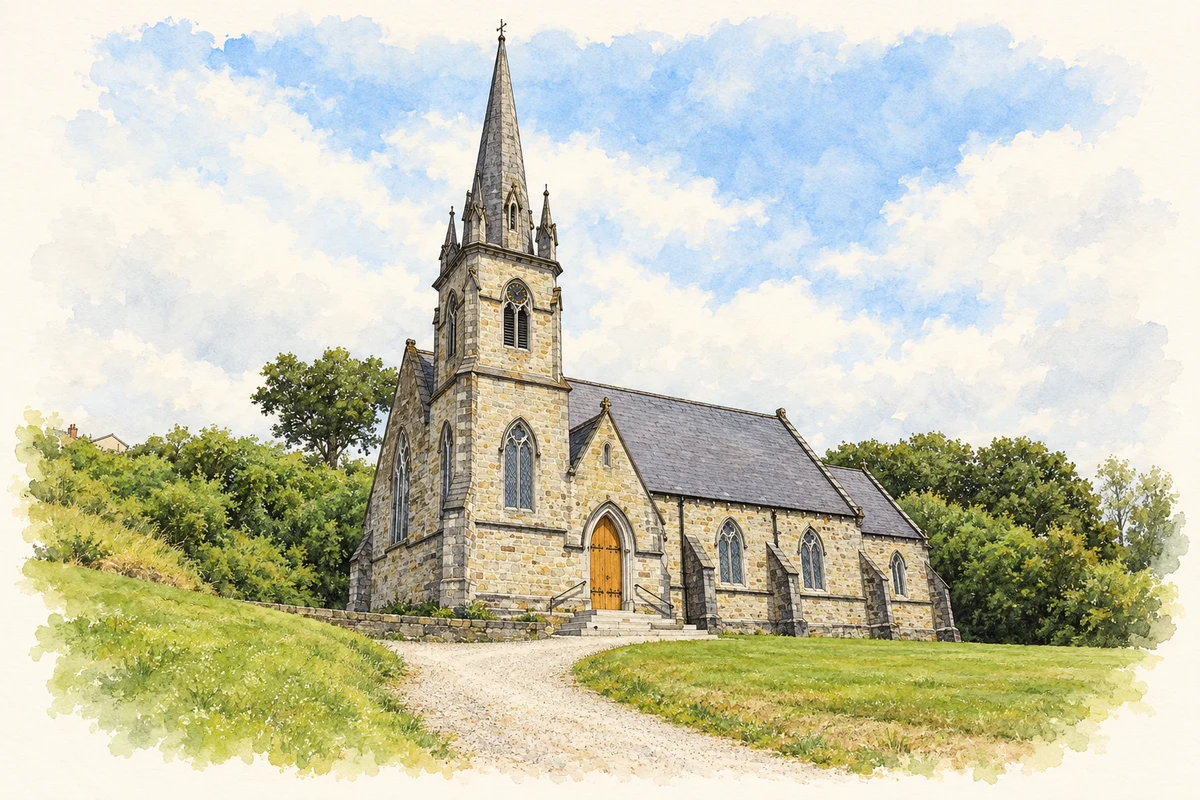
Christ Church was built in 1856 on Main Street at Laherfineen. Its corner tower and slender limestone spire form a prominent feature of Innishannon's skyline. The architectural survey records a three-bay nave, rear transept, chancel and vestry, with a boiler room beneath part of the building. Pinnacles and carefully dressed limestone details give the tower particular emphasis. Slate roofs, decorative ridge tiles and worked stone gable copings complete a church whose materials and craftsmanship record a later phase of investment in the village.[4]
Both counts use the 2016 settlement boundary, allowing like-for-like comparison. CSO supplies the 2022 count on this older boundary for comparison only. The official 2022 Built Up Area has different boundaries.
View population figures
Innishannon — Census 2016 settlement footprint — census population
These are the historical areas published in the 2006 census report. Boundaries may differ between censuses and from modern settlements. Legal towns, environs and suburbs are shown separately; none has been combined into a modern settlement total.
View population figures
Innishannon, Cork — Census town, CSO 2006 report — census population
These are the historical areas published in the 1996 census report. Boundaries may differ between censuses and from modern settlements. Legal towns, environs and suburbs are shown separately; none has been combined into a modern settlement total.
View population figures
Innishannon, Cork — Census town, CSO 1996 report — census population
Figures cover the historical town area printed in the 1986 report. Boundaries may have changed between censuses. Legal town, environs and suburb totals remain separate and differ from modern settlement boundaries.
View population figures
Innishannon, Cork — Census town, CSO 1986 report — census population
These figures use different area definitions. Read the boundary note before comparing them.
Innishannon, Cork
Published census settlement populations
907people · 2016
Settlement boundaries changed during this period. Differences may reflect boundary changes as well as population change. Where a 2011 legal-town-and-environs count is shown, it has not been recalculated onto the 2016 settlement boundary.
Christ Church, Innishannon, County Cork illustration: based on a Christ Church, Innishannon by Jonathan Thacker. AI-assisted watercolour and ink adaptation; cream paper margins added, incidental clutter omitted and fine details simplified. Licence: CC BY-SA 2.0.
 placenames