These Irish name elements are associated with this record in the Logainm glossary.
An element’s translation is a clue, rather than a complete explanation of the name. Its form and meaning depend on local history and the full Irish name.
Recorded forms
Cill Briotáin· Irish · main form · validated name
Kilbrittain· English · main form
Place & story
Layers of Kilbrittain Castle
Kilbrittain Castle was the principal seat of the MacCarthy Riabhach family from the early fifteenth century. Its surviving fabric belongs to several periods: a medieval tower house, eighteenth-century work and later additions. The Stawell family transformed the old stronghold into a country residence, then added battlements and other Gothic features in 1871. Fire damaged the castle in May 1920, and part of the complex was restored in 1968–69 by inventor Russell Winn. Its appearance reflects repeated adaptation rather than one unchanged medieval building.[2]
People & connections
The Book of Lismore’s Kilbrittain beginnings
The manuscript now called the Book of Lismore was compiled in the late fifteenth century for Fínghin Mac Carthaigh Riabhach and his wife Caitilín. University College Cork identifies Kilbrittain Castle as its probable place of production. Its 198 vellum folios include saints’ lives, Irish heroic literature and translations of European works, among them Marco Polo’s travels. The book’s modern name recalls a later home; its patrons and origins connect it firmly with Kilbrittain’s Gaelic lordship.[3]
The whale preserved by the village
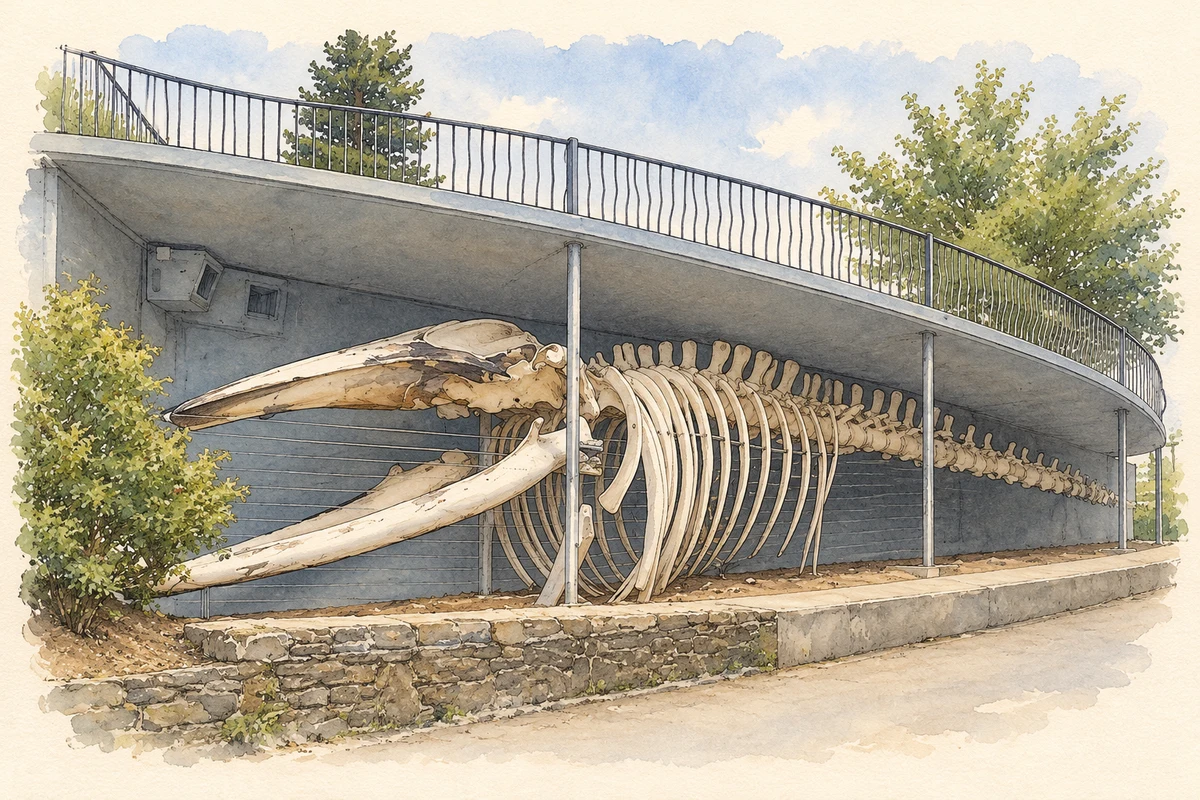
On 15 January 2009, a fin whale stranded at Burren near Kilbrittain and died. The local whale project records how residents worked with scientists and the council to preserve its skeleton. The reassembled bones became a public display in the village, turning an unusual coastal event into an educational landmark. An Irish Whale and Dolphin Group account of a 2010 field weekend independently records visitors viewing the mounted skeleton, confirming that the display was already established by then.[4][5]
Saint Patrick’s before Catholic Emancipation
Saint Patrick’s church at Glanduff dates to 1790 and has a T-shaped plan, with timber galleries extending across the nave and transepts. The architectural inventory records its use by the Bandon Militia during the 1798 rebellion, followed by enlargement in the 1840s. Its formal dedication to Saint Patrick took place on 10 June 1892. Although later refurbishments changed some fabric, the galleries and timber roof preserve a connection with the church’s long history as a gathering place for the parish.[6]
Both counts use the 2016 settlement boundary, allowing like-for-like comparison. CSO supplies the 2022 count on this older boundary for comparison only. The official 2022 Built Up Area has different boundaries.
View population figures
Kilbrittain — Census 2016 settlement footprint — census population
These are the historical areas published in the 2006 census report. Boundaries may differ between censuses and from modern settlements. Legal towns, environs and suburbs are shown separately; none has been combined into a modern settlement total.
View population figures
Kilbrittain, Cork — Census town, CSO 2006 report — census population
These figures use different area definitions. Read the boundary note before comparing them.
Kilbrittain, Cork
Published census settlement populations
216people · 2016
Settlement boundaries changed during this period. Differences may reflect boundary changes as well as population change. Where a 2011 legal-town-and-environs count is shown, it has not been recalculated onto the 2016 settlement boundary.
 placenames