Cromane's peninsula reaches into Castlemaine Harbour. Its community history follows families making land beside the water, rebuilding a football club and defending an unusual foreshore landmark.
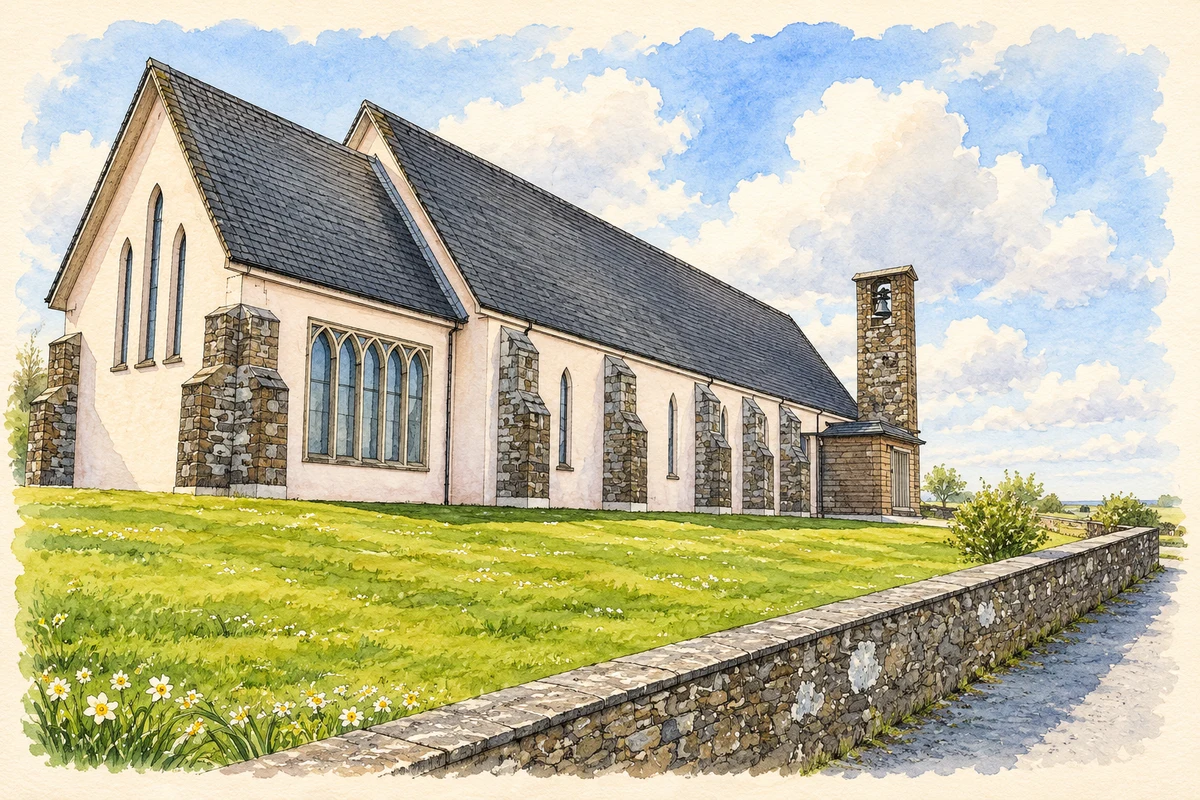
Illustration, Cromane church
⊕Recorded locationCromane52.10620° N · 9.89246° WInteractive map supplied by OpenStreetMap.
A reliable full-name meaning has not been established here. The recorded Irish and English forms are given without an unsupported translation.
Recorded forms
An Cromán· Irish · main form · validated name
Cromane· English · main form
Place & story
Making land along the shore
Nineteenth-century reclamation helped shape Cromane's settlement. Earth and stone embankments enclosed ground for tillage, providing additional land as the population increased. The community's historical account also remembers families displaced during the Famine moving to the coast when they could not afford to emigrate. Farming and work along the shore became intertwined in the growth of the village. Its peninsula projects north into Castlemaine Harbour, with Inch and Rossbeigh visible across the water.[2]
The coastguard station
The British Admiralty built Cromane Coastguard Station in 1866, replacing the closed station at Dunquin on the western Dingle Peninsula. The substantial building became a conspicuous feature of the coastal landscape. It belongs to a wider maritime history in which the shore provided work and brought government services into a dispersed settlement.[2]
People & connections
A club rebuilt after emigration
Pat O'Shea, Michael Riordan and Pat Casey described Cromane's football history for the GAA Oral History Project. A club formed in the 1950s struggled as economic hardship drove players away. A renewed effort in the 1980s faced further obstacles before establishing grounds and facilities. Their memories connect the practical work of sustaining a small club with the achievements of Cromane players Seán O'Sullivan and Donnchadh Walsh for Kerry. O'Shea also recalled his own thirteen years as a Kerry selector, including the 1982 All-Ireland final in which Offaly ended Kerry's attempt at five consecutive titles.[3]
Folklore & tradition
The story attached to the marble
In March 2004 local people mounted a round-the-clock guard over a ten-tonne slab of Spanish marble on Cromane's foreshore when its proposed removal caused a dispute. Community council spokesman Pat Casey told reporter Anne Lucey the local account of its arrival: marble intended for a Killorglin church had fallen while being transferred between vessels around 1840. Residents wanted to display the slab themselves. The episode records how an object on the shore, and the story attached to it, had become part of the community's sense of place.[4]
Both counts use the 2016 settlement boundary, allowing like-for-like comparison. CSO supplies the 2022 count on this older boundary for comparison only. The official 2022 Built Up Area has different boundaries.
View population figures
Cromane — Census 2016 settlement footprint — census population
These are the historical areas published in the 2006 census report. Boundaries may differ between censuses and from modern settlements. Legal towns, environs and suburbs are shown separately; none has been combined into a modern settlement total.
View population figures
Cromane, Kerry — Census town, CSO 2006 report — census population
These are the historical areas published in the 1996 census report. Boundaries may differ between censuses and from modern settlements. Legal towns, environs and suburbs are shown separately; none has been combined into a modern settlement total.
View population figures
Cromane, Kerry — Census town, CSO 1996 report — census population
Figures cover the historical town area printed in the 1986 report. Boundaries may have changed between censuses. Legal town, environs and suburb totals remain separate and differ from modern settlement boundaries.
View population figures
Cromane, Kerry — Census town, CSO 1986 report — census population
These figures use different area definitions. Read the boundary note before comparing them.
Cromane, Kerry
Published census settlement populations
116people · 2016
Settlement boundaries changed during this period. Differences may reflect boundary changes as well as population change. Where a 2011 legal-town-and-environs count is shown, it has not been recalculated onto the 2016 settlement boundary.
 placenames