Milltown’s market history belongs to a much older landscape, where archaeological work has recovered evidence of some of Kerry’s earliest farming communities.
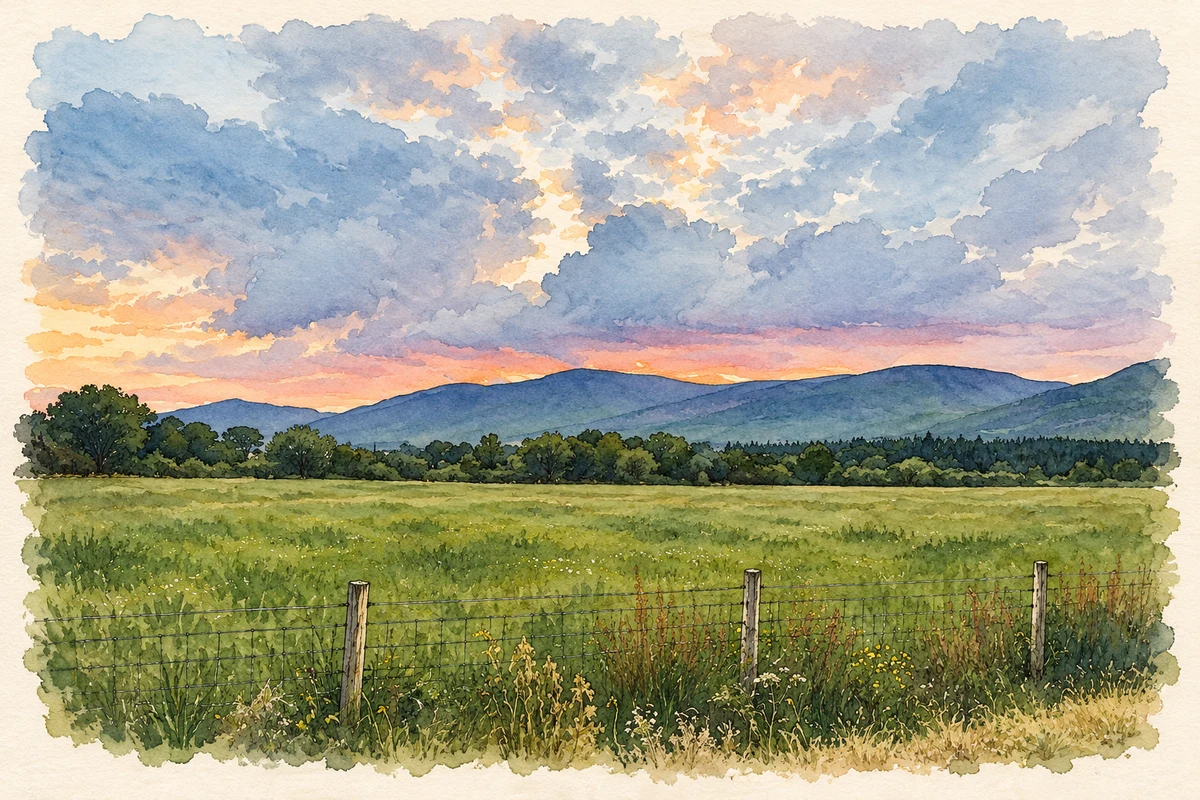
Illustration, countryside near Milltown, County Kerry
⊕Recorded locationMilltown52.14347° N · 9.71708° WInteractive map supplied by OpenStreetMap.
These Irish name elements are associated with this record in the Logainm glossary.
An element’s translation is a clue, rather than a complete explanation of the name. Its form and meaning depend on local history and the full Irish name.
Recorded forms
Baile an Mhuilinn· Irish · main form · validated name
Milltown· English · main form
Place & story
A market town beside the Maine
Samuel Lewis's 1837 account places Milltown on the mail road between Tralee and Cahirciveen, near the river Maine. He describes a Saturday market for corn and potatoes and fairs for farming stock. The market rights were associated with the Godfrey family, whose residence at Kilcoleman Abbey adjoined the town. Lewis also lists a church, chapel, bridewell, dispensary and school. These details describe a small service centre for an agricultural district, with trading, transport and public institutions concentrated together. His figures and observations belong to the years before the Great Famine.[2]
Conserving the tomb at Killaclohane
At nearby Killaclohane, archaeologists intervened in 2015 because a portal tomb was in danger of collapse. The work involved lifting its capstone, straightening the supporting stones and replacing the great slab. Michael Connolly's excavation report records cremated human remains, pottery, flint objects and a broken saddle quern. The pottery suggested use during the fourth millennium BC, with later reuse in the Bronze Age. The excavation also showed that the tomb's builders or users had addressed stability problems in antiquity. Its modern conservation therefore uncovered a much longer history of construction, burial and repair.[3]
People & connections
Denis Sugrue’s record of everyday life
Denis Sugrue combined work as an auctioneer and librarian with photography and local history. His Milltown: Memories of Other Days recorded stories about the town, while his Milltown Notes appeared in The Kerryman for nearly forty years. In 2026 the Milltown History and Heritage Society announced a new edition marking forty years since his death. Edited by John Knightly and Owen O'Shea, it brought his original text together with selected newspaper notes and photographs. Sugrue's work preserves the scale of everyday local experience that can disappear behind accounts of estates, monuments and national events.[4]
Both counts use the 2016 settlement boundary, allowing like-for-like comparison. CSO supplies the 2022 count on this older boundary for comparison only. The official 2022 Built Up Area has different boundaries.
View population figures
Milltown — Census 2016 settlement footprint — census population
These are the historical areas published in the 2006 census report. Boundaries may differ between censuses and from modern settlements. Legal towns, environs and suburbs are shown separately; none has been combined into a modern settlement total.
View population figures
Milltown, Kerry — Census town, CSO 2006 report — census population
These are the historical areas published in the 1996 census report. Boundaries may differ between censuses and from modern settlements. Legal towns, environs and suburbs are shown separately; none has been combined into a modern settlement total.
View population figures
Milltown, Kerry — Census town, CSO 1996 report — census population
Figures cover the historical town area printed in the 1986 report. Boundaries may have changed between censuses. Legal town, environs and suburb totals remain separate and differ from modern settlement boundaries.
View population figures
Milltown, Kerry — Census town, CSO 1986 report — census population
These figures use different area definitions. Read the boundary note before comparing them.
Milltown, Kerry
Published census settlement populations
928people · 2016
Settlement boundaries changed during this period. Differences may reflect boundary changes as well as population change. Where a 2011 legal-town-and-environs count is shown, it has not been recalculated onto the 2016 settlement boundary.
 placenames