 placenames
Dingle
Daingean Uí Chúis
Dingle's history stretches from a sixteenth-century imperial alliance to Harry Clarke's stained glass and the communal music of Wren's Day. The harbour also became inseparable from the wild dolphin Fungie during his decades here.
The name
These Irish name elements are associated with this record in the Logainm glossary.
An element’s translation is a clue, rather than a complete explanation of the name. Its form and meaning depend on local history and the full Irish name.
Recorded forms
- Daingean Uí Chúis · Irish · main form · validated name
- An Daingean · Irish · main form · local name
- Dingle · English · main form
Place & story
An alliance with CharlesV
On 28 April 1529 James, Earl of Desmond, signed an agreement at Dingle with the imperial ambassador Gonçalo Fernández. Desmond transferred his allegiance from HenryVIII to Emperor CharlesV and offered military service, naval bases and commercial advantages. In return, the agreement provided privileges for Desmond's people within the emperor's territories. Historian Declan Downey traces the event through documents in Brussels and the British Library. The treaty gives a striking example of Dingle's place in European political and maritime connections well before its modern visitor trade. [2]
A convent chapel's 1924 windows
At An Díseart, the former Presentation convent contains six two-light windows by Harry Clarke. Mother Superior Sister Ita Macken ordered them in 1922 for an agreed thousand pounds. Full-size cartoons were dispatched in February 1924, followed by the finished windows that spring. Their twelve panels depict episodes from Christ's life within the convent's neo-Gothic chapel, designed by J. J. McCarthy. The centre's surviving commission chronology connects the artwork with the sisters who selected and funded it, as well as with the studio which made it. [3]
The four Wrens
RTÉ's 26 December 2006 report recorded Dingle's Wren's Day preparations and procession. Straw costumes were being made at O'Flaherty's Bar, while the town's four Wrens represented John Street, the Quay, Goat Street and the Green and Gold. Each group had a captain and a white hobby horse, accompanied by musicians playing fifes, whistles and drums. Interviewees described participation passing through families over generations. The broadcast captures a living winter custom in specific streets and workplaces: costume-making, music and neighbourhood allegiance all contributed to the day's public performance. [4]
Fungie and the boatmen
Lighthouse keeper Paddy Ferriter first spotted Fungie at Dingle harbour in 1983. The wild bottlenose dolphin became the focus of boat trips and a lasting feature of local life. When he disappeared in October 2020, boats and divers searched the harbour for a week. Marine biologist Kevin Flannery and local boatmen discussed both his importance to tourism and their uncertainty about his fate in a contemporary RTÉ report. The search brought out the close relationship which had developed between the animal and a community whose working waterfront had helped visitors encounter him. [5]
Geographic information
- Place type
- Town
- County
- Kerry
- Barony
- Corkaguiny
- Civil parish
- Dingle
- Coordinates
- 52.14295, -10.27679
- Logainm ID
- 1416499 ↗
Sources & further reading
- Logainm.ie — Dingle. Place names and geographic record, licensed under CC BY 4.0.
- 28 April 1529: The Treaty of DingleIV · Dr Declan Downey, Dingle History; research cites Brussels and British Library manuscripts
- The Harry Clarke Windows · An Díseart
- Dingle Celebrates the Wren 2006 · RTÉ Archives; Paschal Sheehy report26December2006
- Locals fear strong likelihood Fungie will not return,20 October 2020 · Seán Mac an tSíthigh, RTÉ News
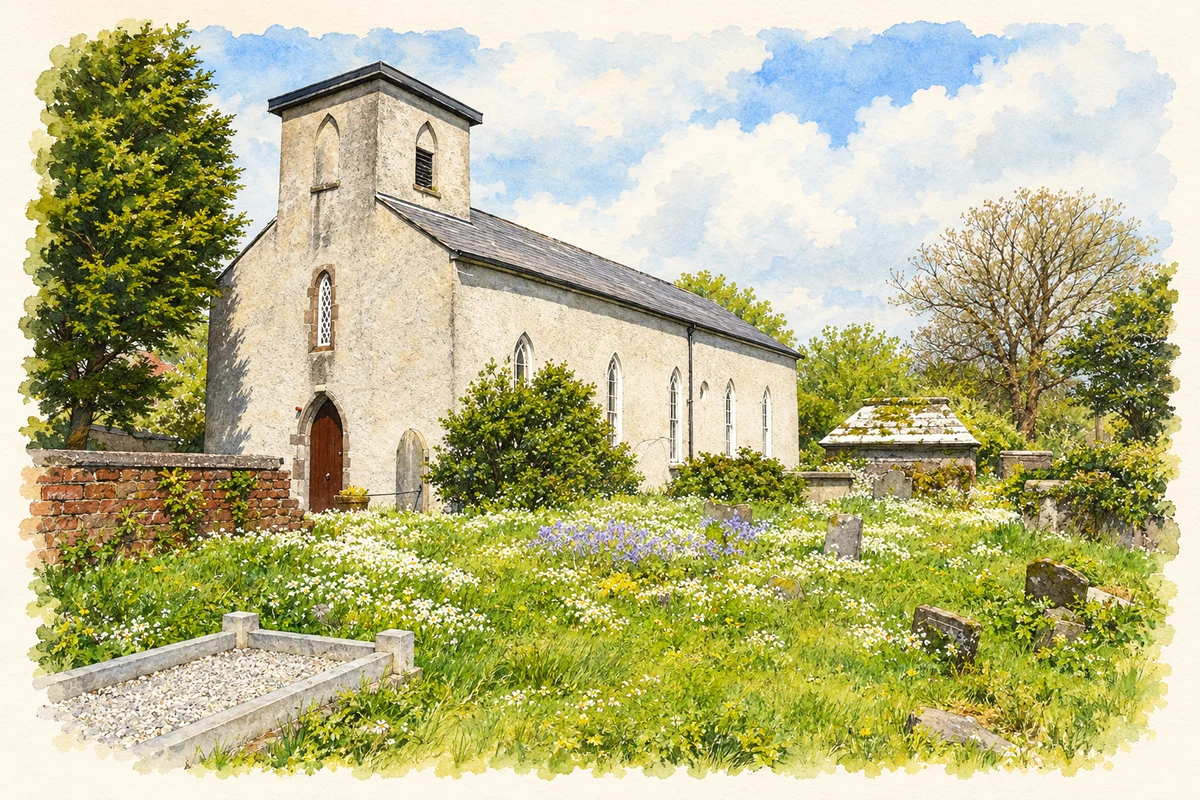
- St James’s Church, Dingle illustration: based on a St James's Church, Church of Ireland, Dingle by Humphrey Bolton. AI-assisted watercolour and ink adaptation; cream paper margins added, incidental clutter omitted and fine details simplified. Licence: CC BY-SA 2.0; adapted illustration distributed under the same licence.
Name record retrieved 2026-10-25 · Source record modified 2026-09-19. How this page was prepared.