These Irish name elements are associated with this record in the Logainm glossary.
An element’s translation is a clue, rather than a complete explanation of the name. Its form and meaning depend on local history and the full Irish name.
Recorded forms
Gníomh go Leith· Irish · main form · validated name
Gneevgullia· English · main form
Gneeveguilla· English · main form · local name
Place & story
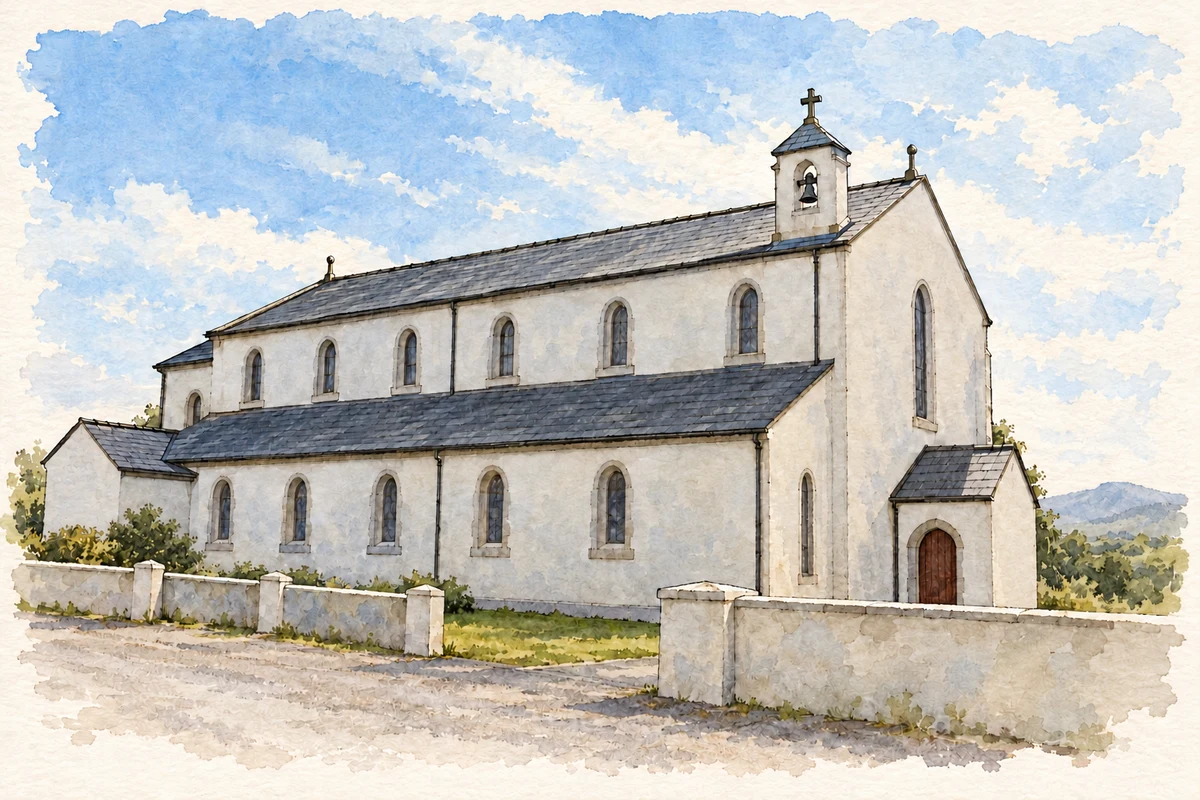
The Church of the Holy Rosary
The Church of the Holy Rosary opened on 10 October 1937. A parish anniversary account recalls Bishop O’Brien opening and dedicating it before a large congregation, with the architect, named as Mr Robinson, presenting him with a ceremonial key. Canon J. O’Sullivan helped finance the church with money donated by his brother. The parish’s own record connects the building with both a public ceremony and the personal gift that contributed to its construction.[2]
People & connections
Éamon Kelly’s seated memorial
A seated statue by Don Cronin commemorates actor and storyteller Éamon Kelly in Gneeveguilla. Born in 1914 in the Gneeveguilla–Rathmore district, Kelly trained in carpentry and later taught technical drawing in Listowel. He and his wife Maura joined the Radio Éireann Players in 1952. His storytelling broadcasts included The Rambling House, while his stage career took him to the Abbey and Broadway. The memorial gives a local setting to the memory of a performer heard by audiences far beyond Kerry.[3]
People & connections
Johnny Cronin from Reaboy to New York
Fiddler Johnny Cronin was born in 1934 at nearby Reaboy, Gneeveguilla. His older brother Paddy learned from Pádraig O’Keeffe, and Johnny developed within that same Sliabh Luachra musical world. He emigrated to Boston in 1956 and later settled in New York, where he performed in Irish bars and recorded with Joe “Banjo” Burke. The Irish Traditional Music Archive also records a reunion with Paddy at a Boston College festival in 1990. His career illustrates how a local instrumental tradition travelled through emigrant communities.[4]
Remembering the moving bog
The Sliabh Luachra cultural trail records a devastating bog slide near Gneeveguilla on 28 December 1896 after prolonged rain. The Donnelly family’s home was swept away; one child survived because she was staying with her grandmother elsewhere. Remembered locally as the moving bog, the disaster belongs to the history of the peatland landscape surrounding the village, alongside its farming and musical associations.[5]
Both counts use the 2016 settlement boundary, allowing like-for-like comparison. CSO supplies the 2022 count on this older boundary for comparison only. The official 2022 Built Up Area has different boundaries.
View population figures
Gneevgullia — Census 2016 settlement footprint — census population
These are the historical areas published in the 2006 census report. Boundaries may differ between censuses and from modern settlements. Legal towns, environs and suburbs are shown separately; none has been combined into a modern settlement total.
View population figures
Gneevgullia, Kerry — Census town, CSO 2006 report — census population
These are the historical areas published in the 1996 census report. Boundaries may differ between censuses and from modern settlements. Legal towns, environs and suburbs are shown separately; none has been combined into a modern settlement total.
View population figures
Gneevgullia, Kerry — Census town, CSO 1996 report — census population
Figures cover the historical town area printed in the 1986 report. Boundaries may have changed between censuses. Legal town, environs and suburb totals remain separate and differ from modern settlement boundaries.
View population figures
Gneevgullia, Kerry — Census town, CSO 1986 report — census population
These figures use different area definitions. Read the boundary note before comparing them.
Gneevgullia, Kerry
Published census settlement populations
256people · 2016
Settlement boundaries changed during this period. Differences may reflect boundary changes as well as population change. Where a 2011 legal-town-and-environs count is shown, it has not been recalculated onto the 2016 settlement boundary.
Church of the Holy Rosary, Gneevgullia illustration: based on a Church of the Holy Rosary Gneeveguilla by FishandChipper. AI-assisted watercolour and ink adaptation; cream paper margins added, incidental clutter omitted and fine details simplified. Licence: CC BY-SA 4.0.
 placenames