Tarbert’s position on the Shannon shaped its trading and administrative buildings, while its most celebrated writer carried memories of the town into a wider artistic world.
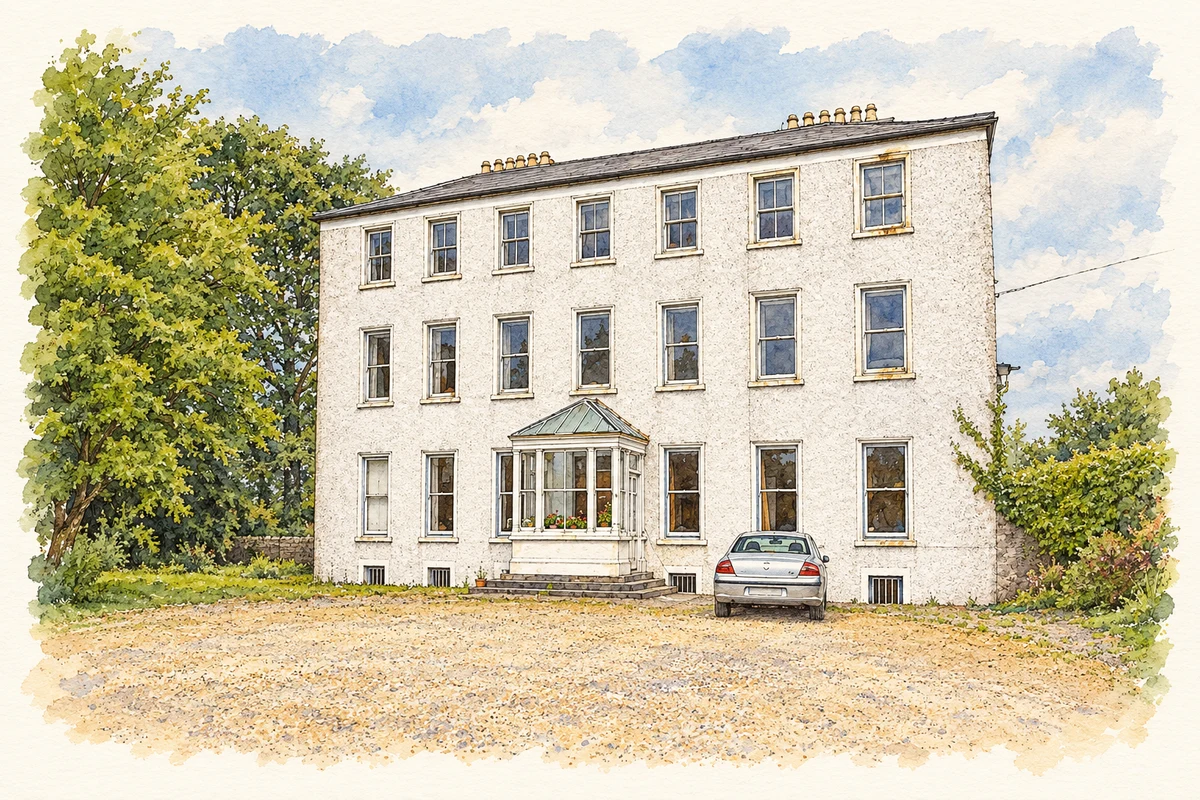
Illustration, Tarbert House, in 2009
⊕Recorded locationTarbert52.57130° N · 9.37544° WInteractive map supplied by OpenStreetMap.
A reliable full-name meaning has not been established here. The recorded Irish and English forms are given without an unsupported translation.
Recorded forms
Tairbeart· Irish · main form · validated name
Tarbert· English · main form
Place & story
A port on the lower Shannon
Samuel Lewis described Tarbert in 1837 as a port with corn stores, a customs station and sheltered anchorage on the lower Shannon. He noted a lighthouse on the island and a battery built during the continental wars to protect the approaches to Limerick. These details show Tarbert's role in a network of river trade and coastal defence. They also distinguish the town itself from the island installations, where navigation, revenue collection and military protection brought different kinds of work to the estuary.[2]
The courthouse and bridewell
Tarbert's courthouse and bridewell were built in 1831. The architectural inventory records a central two-storey block with lower wings, sandstone walls and carefully worked limestone details. Barred openings retain a visible reminder of detention alongside the judicial function. Later conversion into a heritage centre brought extensions incorporating parts of the former yards. The building's balanced frontage can therefore be read alongside the practical arrangements of a small local prison and court, rather than simply as an ornamental civic landmark.[3]
People & connections
Thomas MacGreevy’s beginnings
Poet and art critic Thomas MacGreevy was born in Tarbert in 1893. His mother, Margaret Enright, was a teacher and later headmistress at Tarmons school. After local schooling, he prepared for civil-service examinations through correspondence study. His later life took him to London and Paris, into friendship with Samuel Beckett and work alongside James Joyce, before he became director of the National Gallery of Ireland. Tarbert remained the starting point of a career connecting a small Shannon town with twentieth-century European literature and art.[4]
Both counts use the 2016 settlement boundary, allowing like-for-like comparison. CSO supplies the 2022 count on this older boundary for comparison only. The official 2022 Built Up Area has different boundaries.
View population figures
Tarbert — Census 2016 settlement footprint — census population
These are the historical areas published in the 2006 census report. Boundaries may differ between censuses and from modern settlements. Legal towns, environs and suburbs are shown separately; none has been combined into a modern settlement total.
View population figures
Tarbert, Kerry — Census town, CSO 2006 report — census population
These are the historical areas published in the 1996 census report. Boundaries may differ between censuses and from modern settlements. Legal towns, environs and suburbs are shown separately; none has been combined into a modern settlement total.
View population figures
Tarbert, Kerry — Census town, CSO 1996 report — census population
Figures cover the historical town area printed in the 1986 report. Boundaries may have changed between censuses. Legal town, environs and suburb totals remain separate and differ from modern settlement boundaries.
View population figures
Tarbert, Kerry — Census town, CSO 1986 report — census population
These figures use different area definitions. Read the boundary note before comparing them.
Tarbert, Kerry
Published census settlement populations
540people · 2016
Settlement boundaries changed during this period. Differences may reflect boundary changes as well as population change. Where a 2011 legal-town-and-environs count is shown, it has not been recalculated onto the 2016 settlement boundary.
Tarbert House illustration: based on a Tarbert House by Mike Searle. AI-assisted watercolour and ink adaptation; cream paper margins added, incidental clutter omitted and fine details simplified. Licence: CC BY-SA 2.0.
 placenames