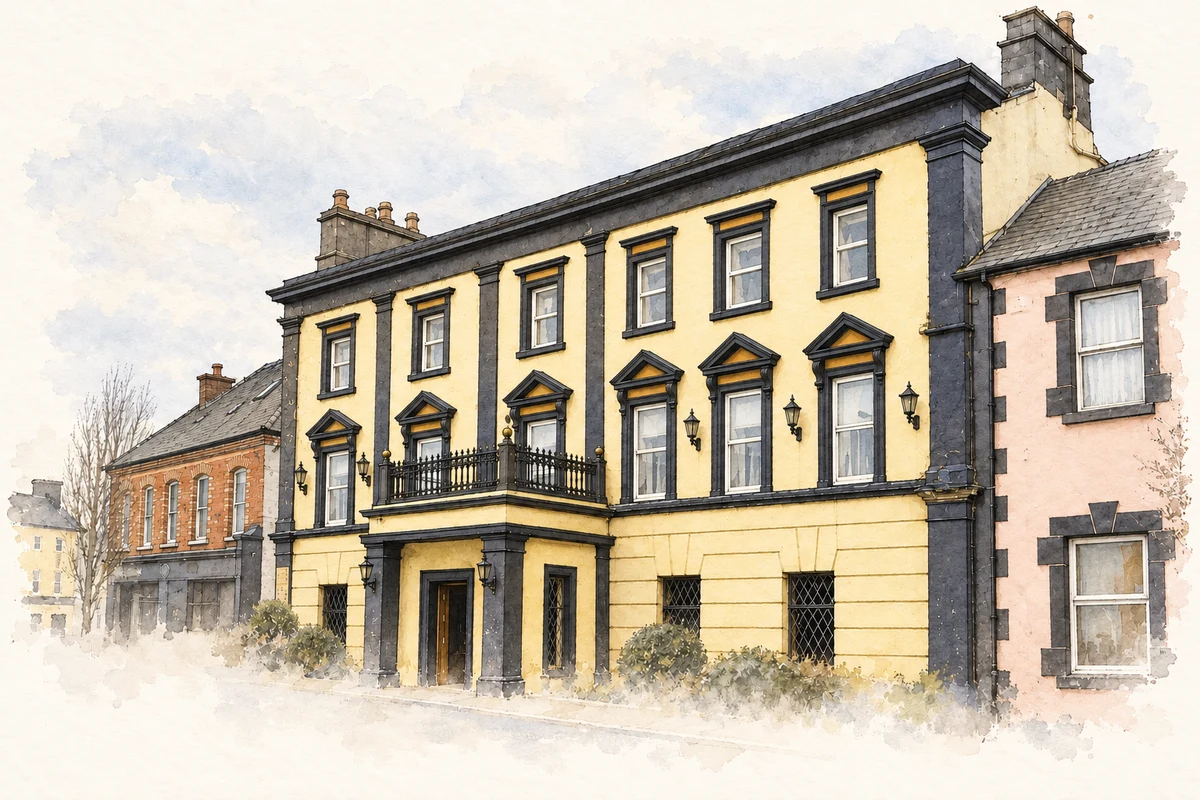
Oldcastle's market square records commercial ambition, while the former workhouse site recalls the civilians interned there during the First World War.
Illustration, Naper Arms Hotel building, Oldcastle, County Meath
⊕Recorded locationOldcastle53.76917° N · 7.15984° WInteractive map supplied by OpenStreetMap.
These Irish name elements are associated with this record in the Logainm glossary.
An element’s translation is a clue, rather than a complete explanation of the name. Its form and meaning depend on local history and the full Irish name.
Recorded forms
An Seanchaisleán· Irish · main form · validated name
Oldcastle· English · main form
Place & story
A town shaped by yarn
Oldcastle developed into an important eighteenth-century market town under the Naper family of Loughcrew. Meath's conservation appraisal describes its yarn market as the largest in the country. Trade concentrated on an elevated, irregular triangular square, with streets extending along four of the five approaching roads. The Napers' improvements gave the town much of its Georgian appearance. The approach from Castlepollard still reveals the way its commercial centre occupies the higher ground.[2]
The Naper Arms on the square
The Naper Arms Hotel, built around 1860, presents a substantial three-storey frontage towards the former market house. Its Tuscan entrance porch and elaborate rendered decoration made an imposing statement in a trading town. Pilasters articulate the corners, while the treatment of the windows distinguishes the different floors. These details provide a Victorian counterpart to the square's older market buildings and preserve evidence of the investment that commerce brought to Oldcastle.[3]
People & connections
Aloys Fleischmann in internment
During the First World War, Oldcastle Workhouse became an internment camp for almost six hundred foreign nationals. Among them was the musician Aloys Fleischmann, whose detention separated him from his Irish wife and son for more than four years. The National Library's wartime exhibition includes his experience among the lives displaced by the conflict.[4]
Objects made behind the wire
Rings made by an Oldcastle internee survive as evidence of craft within the camp. Noel French's object history also records contemporary reports of prisoners making intricate toys with pocket knives. Such objects give a tangible scale to this episode, alongside the administrative record of detention. The internees left Oldcastle on a special train in May 1918, travelling through Dublin's North Wall before their transfer to Knockaloe on the Isle of Man.[5]
Both counts use the 2016 settlement boundary, allowing like-for-like comparison. CSO supplies the 2022 count on this older boundary for comparison only. The official 2022 Built Up Area has different boundaries.
View population figures
Oldcastle — Census 2016 settlement footprint — census population
These are the historical areas published in the 2006 census report. Boundaries may differ between censuses and from modern settlements. Legal towns, environs and suburbs are shown separately; none has been combined into a modern settlement total.
View population figures
Oldcastle, Meath — Census town, CSO 2006 report — census population
These are the historical areas published in the 1996 census report. Boundaries may differ between censuses and from modern settlements. Legal towns, environs and suburbs are shown separately; none has been combined into a modern settlement total.
View population figures
Oldcastle, Meath — Census town, CSO 1996 report — census population
Figures cover the historical town area printed in the 1986 report. Boundaries may have changed between censuses. Legal town, environs and suburb totals remain separate and differ from modern settlement boundaries.
View population figures
Oldcastle, Meath — Census town, CSO 1986 report — census population
These figures use different area definitions. Read the boundary note before comparing them.
Oldcastle, Meath
Published census settlement populations
1,383people · 2016
Settlement boundaries changed during this period. Differences may reflect boundary changes as well as population change. Where a 2011 legal-town-and-environs count is shown, it has not been recalculated onto the 2016 settlement boundary.
Naper Arms Hotel building, Oldcastle, County Meath illustration: based on a The Naper Arms Hotel by HENRY CLARK. AI-assisted watercolour and ink adaptation; cream paper margins added, incidental clutter omitted and fine details simplified. Licence: CC BY-SA 2.0.
 placenames