Ballylongford's history reaches from the O'Connor castles and friary on the Shannon to the burning of its streets in 1921 and Brendan Kennelly's literary childhood.
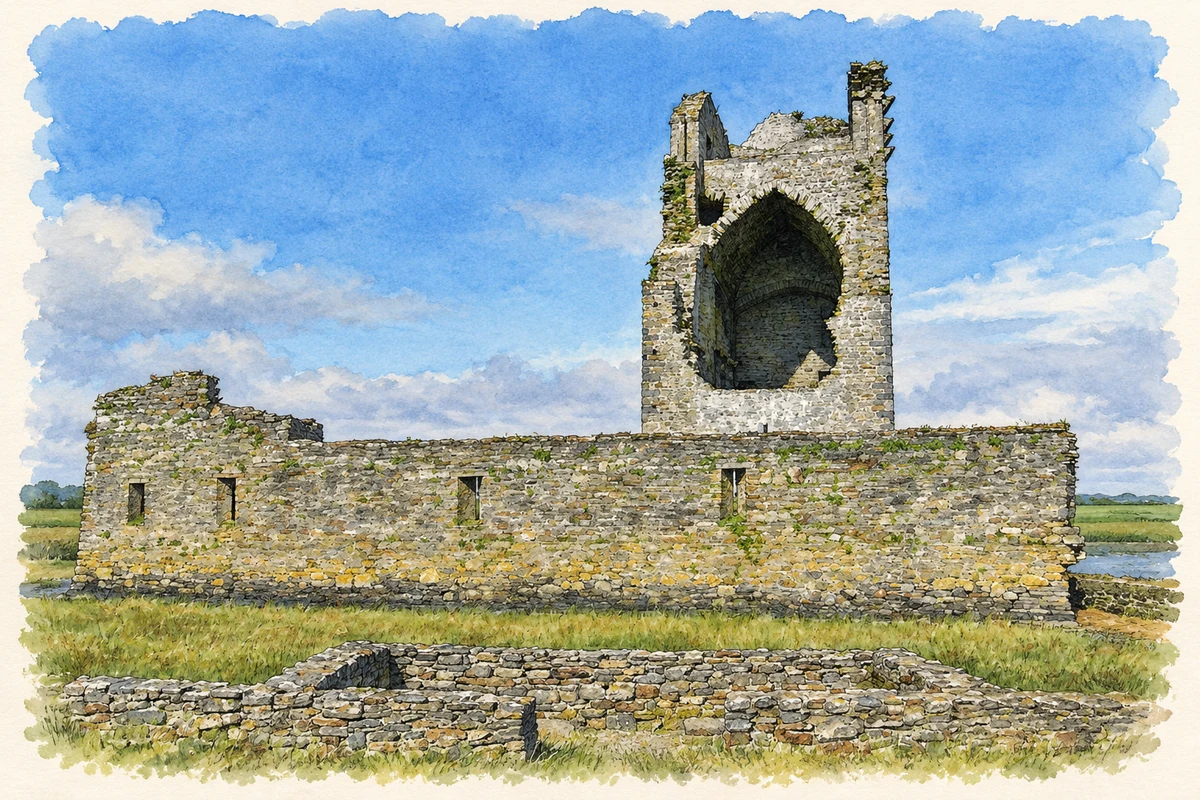
Illustration, Carrigafoyle Castle, near Ballylongford
⊕Recorded locationBallylongford52.54778° N · 9.47863° WInteractive map supplied by OpenStreetMap.
These Irish name elements are associated with this record in the Logainm glossary.
An element’s translation is a clue, rather than a complete explanation of the name. Its form and meaning depend on local history and the full Irish name.
Recorded forms
Béal Átha Longfoirt· Irish · main form · validated name
Ballylongford· English · main form
Place & story
Watching the Shannon
Carrigafoyle Castle, a short distance from Ballylongford, guarded shipping routes towards Limerick from a rocky position on the Shannon estuary. The Office of Public Works dates the tower house to the late fifteenth century and associates its construction with Connor Liath O'Connor. Water surrounded it at high tide, while a dock allowed boats to reach the fortress. During the Second Desmond Rebellion, Sir William Pelham's army bombarded it at Easter 1580. The collapse of the western wall and the killing of its defenders broke this important local stronghold.[2]
A Franciscan foundation
Nearby Lislaughtin preserves the remains of a late-medieval Franciscan friary founded by John O'Connor Kerry. A papal licence followed in 1477, and John was buried there in 1485. Its surviving church retains elaborate pointed windows and tomb recesses, evidence of the patronage directed towards the house. A silver processional cross commissioned in 1479 survives in the National Museum of Ireland. The friary suffered violent attacks in 1580 and during the Cromwellian campaign; its ruins belong to the same contested estuary landscape as Carrigafoyle.[3]
The burning of the village
Historian Mary McAuliffe's account for Kerry Writers' Museum places the burning of Ballylongford in the early hours of 23 February 1921, after two members of the Crown forces had been killed the previous day. The reprisals destroyed business premises and private homes, including shops, a bakery and labourers' houses. McAuliffe draws attention to the experience of civilians and to the difference between inherited family memory and the details recoverable from testimony and contemporary newspapers. The damage was a rupture in an ordinary commercial and domestic streetscape.[4]
People & connections
Brendan Kennelly’s crossroads childhood
Brendan Kennelly was born in Ballylongford in 1936 and grew up in his parents' pub at the village crossroads. Trinity College Dublin's account describes a childhood of singing, storytelling and conversation with local customers. He attended the village national school before continuing his education in Tarbert and at Trinity. Ballylongford also informed Deevna, the fictional village in his 1963 novel The Crooked Cross. His later career as Professor of Modern Literature brought him far beyond North Kerry, while the village remained part of his imaginative landscape.[5]
Both counts use the 2016 settlement boundary, allowing like-for-like comparison. CSO supplies the 2022 count on this older boundary for comparison only. The official 2022 Built Up Area has different boundaries.
View population figures
Ballylongford — Census 2016 settlement footprint — census population
Ballylongford, Kerry — Census town, CSO 2006 report
2002–2006: census town
406people · 2006
These are the historical areas published in the 2006 census report. Boundaries may differ between censuses and from modern settlements. Legal towns, environs and suburbs are shown separately; none has been combined into a modern settlement total.
View population figures
Ballylongford, Kerry — Census town, CSO 2006 report — census population
Ballylongford, Kerry — Census town, CSO 1996 report
1991–1996: census town
499people · 1996
These are the historical areas published in the 1996 census report. Boundaries may differ between censuses and from modern settlements. Legal towns, environs and suburbs are shown separately; none has been combined into a modern settlement total.
View population figures
Ballylongford, Kerry — Census town, CSO 1996 report — census population
Ballylongford, Kerry — Census town, CSO 1986 report
1981–1986: census town
523people · 1986
Figures cover the historical town area printed in the 1986 report. Boundaries may have changed between censuses. Legal town, environs and suburb totals remain separate and differ from modern settlement boundaries.
View population figures
Ballylongford, Kerry — Census town, CSO 1986 report — census population
These figures use different area definitions. Read the boundary note before comparing them.
Ballylongford, Kerry
Published census settlement populations
391people · 2016
Settlement boundaries changed during this period. Differences may reflect boundary changes as well as population change. Where a 2011 legal-town-and-environs count is shown, it has not been recalculated onto the 2016 settlement boundary.
 placenames